
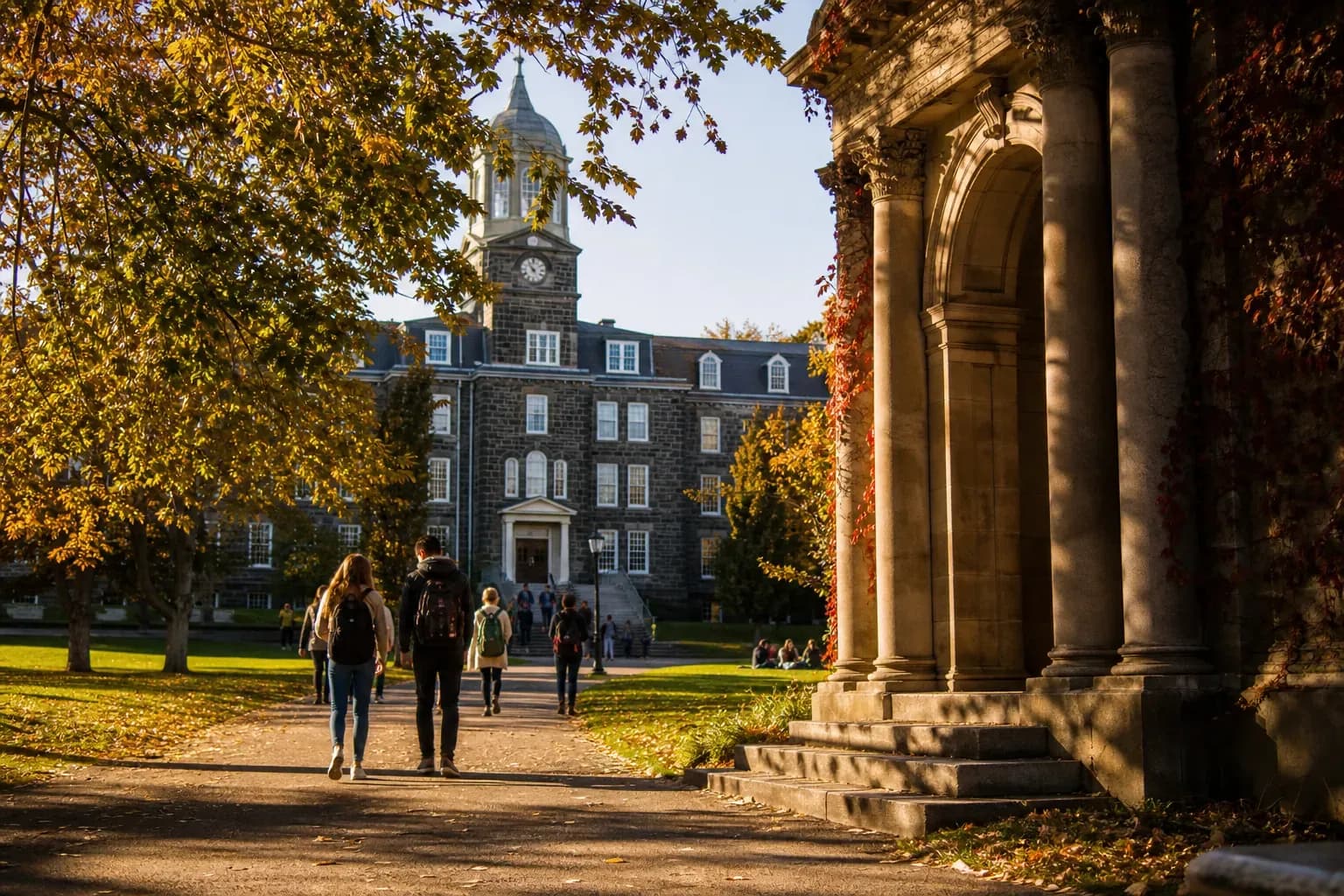
Dalhousie University: No. 1 in Ocean Sciences, the AIP Atlantic Fast Track to PR, and the Lowest Tuition in the U15
Published on January 20, 2026
Dalhousie University, often shortened to Dal, is one of the Canadian universities study-abroad families most need to know, yet it is also the U15 university most often overlooked. It is ranked #270-300 globally in QS 2026, is a member of Canada’s U15 group of research-intensive universities (yes, Dal is in the U15), ranks #11 in Maclean’s Medical Doctoral category, and was founded in 1818, making it the fourth-oldest university in Canada. But what Taiwanese families should really notice is Dal’s double value advantage: the lowest tuition across the U15 plus the AIP (Atlantic Immigration Program) fast-track PR pathway.
To understand Dal, remember three things first. First, tuition of CAD $24-36K is the lowest in the U15: about 40% less than U of T, 30% less than UBC, and 20% less than McGill. Second, AIP is one of Canada’s fastest PR pathways: a 1-year contract from a designated employer in one of the four Atlantic provinces (NS, NB, PE, NL) plus a Dalhousie degree creates a direct PR pathway, 12-18 months faster than Express Entry. Third, Dal’s ocean sciences ecosystem is unique in Canada: with partnerships including the Bedford Institute of Oceanography and the Ocean Tracking Network, Dal is at the center of Canadian ocean research.
Halifax is Canada’s second-largest natural harbour, a naval port, NATO’s Atlantic command center, and a UNESCO-recognized cultural harbour city. If your child’s budget is CAD $30-40K, they do not want the competition of Toronto, and they are interested in ocean studies, law, pharmacy, or medicine, Dal is Canada’s best-value choice. Most Taiwanese parents still have not fully understood that value.
1. Basic Information
| Item | Details |
|---|---|
| Founded | 1818 (fourth-oldest in Canada) |
| Location | Halifax, Nova Scotia (largest city in Atlantic Canada, by Halifax Harbour) |
| Campus | Main Studley campus of about 80 acres + two satellite campuses (Sexton, Carleton) + Truro agricultural campus |
| Undergraduates | ~16,000 |
| Graduate students | ~5,000 |
| Total enrollment | ~21,000 |
| Student-faculty ratio | 1:15 |
| Motto | Ora et Labora (Pray and Work) |
2. World Rankings
| Ranking | Position |
|---|---|
| QS World 2026 | #270-300 |
| THE World 2025 | #251-300 |
| US News Global Universities 2024-25 | #261 |
| Maclean’s Canadian Medical Doctoral Universities | #11 |
| QS Marine / Ocean Sciences | Global Top 50 (No. 1 in Canada) |
| QS Law | Global #150-200 |
Dal ranks slightly below U of T, McGill, UBC, and Queen’s in broad overall rankings, but its U15 membership, No. 1 ocean sciences position, and long-established Schulich Law reputation place its academic level far above non-U15 schools at a similar price point.
3. Admissions Data (Fall 2024 Entry)
| Indicator | Figure |
|---|---|
| Overall applicants | ~20,000 |
| Overall acceptance rate | About 67% (relatively friendly for an Atlantic Canadian flagship university) |
| Faculty of Medicine (MD) | About 6% |
| Faculty of Dentistry | About 8% |
| Pharmacy | About 15% |
| Schulich School of Law (JD) | About 18% |
| Engineering | About 35% |
| Computer Science | About 30% |
| Yield Rate | About 38% |
Dal’s defining admissions feature is this: an overall acceptance rate of 67% makes it the most accessible university in the U15, while its professional schools (MD, Dentistry, Pharmacy, Law) remain highly competitive. Undergraduate Engineering and CS are relatively international-student friendly, which is one of Dal’s biggest draws.
International Student Standards (Direct Undergraduate Entry)
| Test / Requirement | Recommended Score |
|---|---|
| High school average (general programs) | 75%+ (IB 26+) |
| High school average (CS / Engineering) | 80%+ (IB 28+) |
| High school average (Pharmacy / Health Sci) | 85%+ (IB 32+) |
| SAT | 1100+ (1300+ recommended for CS) |
| ACT | 22+ (28+ recommended for CS) |
| IELTS | 6.5 (6.0 in each band) |
| TOEFL iBT | 90 (Writing 20+) |
International Students
- International students make up about 23% of the student body (high for an Atlantic Canadian university because AIP is friendly)
- Students come from 115+ countries
- Around 5-15 Taiwanese undergraduates are admitted each year, mostly in CS, Engineering, Marine Affairs, and Pharmacy
4. Tuition and Financial Aid (International Student Perspective)
2024-2025 Tuition (CAD/year)
| Item | Amount |
|---|---|
| Tuition - Arts & Social Science | CAD $24,000-$28,000 |
| Tuition - Science | CAD $26,000-$30,000 |
| Tuition - Engineering | CAD $30,000-$34,000 |
| Tuition - Computer Science | CAD $30,000-$34,000 |
| Tuition - Management (Rowe Business) | CAD $28,000-$32,000 |
| Tuition - Pharmacy | CAD $32,000-$36,000 |
| Residence (on campus) | CAD $9,000-$12,000 |
| Food + miscellaneous | CAD $5,000-$7,000 |
| Total (general programs) | CAD $38,000-$47,000/year |
| Total (CS / Engineering / Pharmacy) | CAD $44,000-$53,000/year |
Compared with other U15 universities: undergraduate CS / Engineering at U of T is CAD $90K+, UBC is CAD $75K+, McGill is CAD $65K+, and Queen’s is CAD $80K+. Dal is the lowest-cost U15 option, saving CAD $100K-$200K over four years (about NTD 2.3-4.6 million).
Financial Aid for International Students
- International Major Entrance Scholarship: CAD $20,000-$40,000 over 4 years
- Dalhousie University Entrance Scholarship: CAD $1,500-$5,000, automatically considered
- Killam Scholarships (graduate students): CAD $30,000/year
- Compared with equivalent U.S. schools at USD $55K+, Dal at CAD $44K is the best-value low-entry-cost option among U15-level research universities worldwide.
5. Academic Structure / Signature Programs
Faculty Structure
Dal has 13 faculties and schools, making it a highly comprehensive mid-sized Canadian university.
Signature Programs
- Schulich School of Law: Canada’s second-oldest law school, founded in 1883 and second only to McGill. The JD program is highly competitive, and graduates are main recruits for law firms in Toronto, Halifax, and Calgary.
- Faculty of Medicine: Atlantic Canada’s leading medical school, founded in 1868, and a major physician-training center for the four Atlantic provinces.
- Faculty of Computer Science: One of the few dedicated Faculties of CS in Canada, as most universities place CS under Science or Engineering. The Bachelor of Applied Computer Science with Co-op is its flagship.
- Rowe School of Business: Atlantic Canada’s top business school. AACSB accredited, with BCom and MBA programs.
- Faculty of Marine Affairs / Marine Biology: Canada’s only dedicated Marine Affairs program, working closely with the Bedford Institute of Oceanography.
- College of Pharmacy: Atlantic Canada’s only pharmacy school, offering the PharmD program.
- Faculty of Agriculture (Truro campus): Founded in 1905 and among Canada’s top agricultural research institutions.
- Faculty of Dentistry: One of Canada’s long-established dental schools, founded in 1908.
Ocean Research
- Ocean Tracking Network (OTN): A global ocean-tracking research network led by Dal
- Bedford Institute of Oceanography (BIO): Canada’s federal ocean research institute, located near Halifax and closely connected with Dal
- Ocean Frontier Institute (OFI): A Dal + UPEI + Memorial University alliance supported by CAD $220 million in Canadian government funding
Marine Biology, Marine Affairs, and Oceanography at Dal are world-class. Dal is the only university in Canada with a full-spectrum ocean research matrix.
Co-op Program
- Many faculties offer Co-op, including CS, Engineering, Management, and Marine Biology
- Employers include IBM Halifax, Lockheed Martin, Aerospace BC, Microsoft, and Nova Scotia ocean research organizations
6. Campus Culture / Institutional Personality
Dal’s campus culture can be summarized in one line: Atlantic classical character + ocean atmosphere + diverse and friendly community. Students are generally more relaxed than at U of T and less conservative than at Queen’s. Halifax is the cultural center of Canada’s East Coast, with music festivals (Halifax Pop Explosion), harbour festivals (Halifax Busker Festival), and dense historic landmarks.
Campus Traditions
- Tigers School Spirit: Dal’s varsity teams became the Tigers in 1860, making them among Canada’s earliest professionalized varsity teams
- Dal vs Acadia Football: A traditional Atlantic rivalry held annually since 1879
- Studley Quad: A cluster of Halifax heritage spaces dating back to the 1820s, formed by four campus quads
- Henry Hicks Building: A red-brick emblematic campus building opened in 1968
- Killam Memorial Library: The main library
Student Organizations
- 200+ student clubs
- DSU (Dalhousie Student Union) is the student union
- Dal TSA, the Taiwanese student association, is small but close-knit
- Halifax Pier 21 Immigration Museum is within walking distance, adding to the city’s multicultural atmosphere
Sports Culture
- Varsity team name: Tigers (renamed in 1860, among Canada’s earliest professionalized varsity teams)
- Main sports: football, basketball, ice hockey, soccer
- Sports atmosphere is moderate. The Dal vs Acadia rivalry is a tradition, but overall school spirit is not as intense as at Queen’s or Western
7. Location / Campus Environment
City Positioning
Halifax is Canada’s second-largest natural harbour after Vancouver, NATO’s Atlantic command center, and the base of the Royal Canadian Navy’s Atlantic Fleet. With a population of about 450,000, it is the largest city in the four Atlantic provinces. Halifax is Canada’s East Coast cultural center, with strong music, literature, ocean research, and military history.
Compared with megacities like Toronto and Vancouver, Halifax is a refined mid-sized harbour city. You can walk across downtown in 20 minutes, stroll along the Halifax Harbour waterfront, visit the Pier 21 immigration museum, tour the Halifax Citadel historic site, and spend time in the Victorian Public Gardens.
Dal’s main Studley campus is in southwest Halifax, about a 15-20 minute walk from downtown. The campus is close to Halifax Harbour, and students can walk to the waterfront in 5 minutes to see cargo ships and naval vessels.
Climate
- Winter: -5°C to +5°C (warmer than inland Toronto / Montreal at around -10°C because of the Atlantic maritime climate)
- Summer: 18-25°C, cooled by sea breezes
- Spring and autumn: foggy and rainy, with the heaviest fog from April to June
- Halifax has one of the mildest climates in Eastern Canada, and is more livable than St. John’s, Newfoundland
Campus Landmarks
- Henry Hicks Building: Red-brick emblematic campus building opened in 1968
- Killam Memorial Library: Main library
- Studley Quad: 1820s heritage area with four quads
- Life Sciences Centre: Medicine / Science teaching building
- Sexton Campus: Engineering campus near downtown
- Pier 21: Canada’s immigration museum, not on campus but a 15-minute walk away
8. Research and Resources
Libraries
- 5 branch libraries with 2 million volumes
- Killam Memorial Library is the main library
Notable Research Centers
- Ocean Tracking Network (OTN): A global ocean-tracking research network led by Dal, spanning 23 countries
- Bedford Institute of Oceanography (BIO): Federal ocean research institute working with Dal
- Ocean Frontier Institute (OFI): Supported by CAD $220 million in government funding
- Brain Repair Centre: Neuroscience research
- Pharmaceutical Research Institute
9. Notable Alumni
- Politics: R.B. Bennett (former Prime Minister of Canada, 1930-1935), John Hamm (former Premier of Nova Scotia), Robert Stanfield (PC leader), Charles Vincent Massey (former Governor General of Canada)
- Business: Frank Sobey (founder of Sobeys, Canada’s second-largest grocery chain), Sir Frederick Banting (briefly served at Dal Medicine, co-discoverer of insulin)
- Academia / Medicine: Stanford Reid (historian), Lulu Keating (media producer)
- Performing Arts: Donald MacKay (music), Buddy MacMaster (fiddler)
- Oceanography / Environment: Boris Worm (marine ecologist, Dal professor, known for global fisheries-collapse research)
10. Dalhousie Facts
- Dal was founded in 1818, 49 years before Canadian Confederation: It was founded by Lord Dalhousie, then Governor of Nova Scotia, and takes its name from a British aristocratic family.
- Schulich Law, founded in 1883, is Canada’s second-oldest law school: It is second only to McGill Faculty of Law, founded in 1848.
- Pier 21 is Canada’s version of Ellis Island: Between 1928 and 1971, 1 million immigrants entered Canada through this site, now an immigration museum. Dal students can walk there.
- The Halifax Explosion of 1917 was the world’s largest non-nuclear explosion: The French munitions ship SS Mont-Blanc exploded in Halifax Harbour, killing 2,000 people. Dal’s medical school handled much of the major casualty treatment, and the disaster helped turn Dal Medicine into Atlantic Canada’s medical center.
- Frank Sobey, founder of the Sobeys grocery chain, was a Dal alumnus: Sobeys is Canada’s second-largest grocery chain after Loblaws and is headquartered in Stellarton, Nova Scotia.
11. Typical Admitted Student Profile
- High school average (converted): 78-88%+ (IB 28+, A-Level BBB+, top 35% of Taiwanese high schools)
- SAT 1180+ (1300+ recommended for CS)
- IELTS 6.5+ / TOEFL 90+
- Marine Biology / Marine Affairs recommendation: ocean-related volunteering, summer programs, or a personal statement emphasizing passion for the ocean
- Pharmacy recommendation: chemistry / biology background plus pharmacist-shadowing experience
- Unlike the U.S. Common App, Dal does not require students to write a life story. Dal values academic fit
- Dal is friendly to Taiwanese IB / A-Level / top 35% high school students. It is the most accessible university in the U15 and the best option for families with a CAD $40-50K budget
12. What Kind of Student Is Dalhousie Right For?
✓ Good fit for:
- Families with a CAD $38-53K/year budget (the lowest in the U15)
- Students who want oceanography, marine biology, ocean policy, or Marine Affairs (unique in Canada)
- Students oriented toward professional schools such as Law, Pharmacy, Medicine, or Dentistry
- Students who want a mid-sized city, seaside living, and less crowding
- Families planning to stay in Canada after graduation and willing to use the AIP Atlantic fast-track PR pathway
- Students who do not want the IELTS + Co-op + Bay Street competition of Toronto / Vancouver
- IB / A-Level / top 35% high school students who want a U15 education but have a limited budget
✗ May not be ideal for:
- Students who want big-city life and a major tech-hub environment (Halifax is not a tech hub)
- Students who must enter Bay Street investment banking or McKinsey (Dal’s alumni network is concentrated in Atlantic Canada, with some presence in Toronto)
- Students who dislike foggy, rainy maritime climates
- Students who want intense school spirit or Greek Life (Dal’s sports culture is moderate)
- Students who strongly need a Chinese-speaking or Asian cultural community (Halifax has a lower Asian population share than Toronto / Vancouver)
13. Canada Study + Immigration Pathway Advantages
Dal’s value in Canadian immigration pathways is extremely high and highly underrated. AIP (Atlantic Immigration Program) is one of Canada’s fastest PR pathways, and when combined with Dal’s U15 status and affordable tuition, it becomes a best-value route.
PGWP (Post-Graduation Work Permit)
After completing a Dal degree program of at least 8 months, graduates can apply for a 3-year Open Work Permit, with no restriction by major. The language requirement is IELTS General CLB 7 (6.0 in each band), which Taiwanese students usually meet with IELTS 6.5-7.0.
AIP (Atlantic Immigration Program): Dal’s Biggest Advantage
AIP is an employer-driven PR pathway shared by the four Atlantic provinces (Nova Scotia, New Brunswick, Prince Edward Island, Newfoundland and Labrador). It does not use the Express Entry pool and is not affected by CRS cut-offs:
- Requires a 1-year contract from an AIP designated employer (NS has 500+ designated employers, including Sobeys, Nova Scotia Health, Lockheed Martin, and IBM Halifax)
- Dal graduate + designated employer offer = eligibility for the AIP graduate stream (no need to accumulate 1 year of work experience)
- Language requirement is CLB 5 (IELTS General 4.5), more accessible than EE CLB 7
- Processing time is 6 months (vs Express Entry at 12-18 months)
- 12-18 months faster than Express Entry
Typical timeline:
- T0: Start at Dal
- T0-T48m: 4-year undergraduate degree (CS / Engineering / Pharmacy)
- T48m: Graduate + designated employer offer + apply through AIP
- T48-T54m: AIP processing (6 months)
- T54m: PR landing (around age 22-23)
Compared with the EE route (graduate at 22 + 1 year of work + EE draw + 6 months processing = PR at 25), the AIP pathway is 2-3 years faster.
Nova Scotia PNP (NSNP)
NS has two main streams:
1. NS Labour Market Priorities Stream
- Opened by IRCC from time to time for specific NOC occupations
- Suitable for Dal CS / Engineering / Healthcare graduates
2. NS Skilled Worker / Entrepreneur Stream
- Requires a full-time job offer from an NS employer + 6 months of work experience
- Can be aligned with EE through the NS Express Entry stream, adding CRS +600
Express Entry / CEC
If graduates do not use AIP, Dal graduates can still use EE / CEC:
- 2026 Q1 CEC cut-offs are about 521-547 for general rounds
- STEM category 481-524, French category 379-428
- A 24-year-old Dal CS / Engineering graduate with 1 year of work experience and IELTS 7.0: CRS about 500-530
Impact of the 2024-2025 International Student Cap
NS is one of the provinces least affected by the cap, with undergraduate study permit allocation down 19% (31 percentage points lighter than Ontario’s 50% drop). As a U15 research university, Dal’s master’s and doctoral programs are relatively protected. Undergraduate applicants should pay attention to PAL documentation.
Value Comparison with Equivalent U.S. Schools
| Item | Dalhousie | Comparable U.S. Schools (U of New Hampshire / U of Maine) |
|---|---|---|
| QS 2026 | #270-300 | UNH #602 / U Maine #1001+ |
| Tuition (international undergrad) | CAD $30K (USD $22K) | USD $40K-$45K |
| U15 / research level | U15 member (top 15 in Canada) | UNH / U Maine not top-tier R1 equivalents |
| Ocean research | OTN + BIO + OFI (top-tier in Canada) | Moderate |
| Post-graduation stay pathway | 3-year PGWP + AIP fast track (6 months) | OPT 1-3 years + H-1B lottery |
| Permanent residency | PR at age 22-24 (AIP pathway) | OPT 1-3 years + H-1B + green card in 5-10 years |
Dal’s four-part combination of “U15 + No. 1 in ocean sciences + CAD $30K tuition + AIP 6-month PR” is one of the highest-value U15 university pathways in the world.
Conclusion
Dal is right for Taiwanese families whose mindset is: “My budget is CAD $40K-50K, I do not want the competition of Toronto or Vancouver, and I want a faster path to Canadian PR.” It is not the kind of downtown megacity international academic machine that U of T is, nor is it the small-town Ivy-style, elite close-knit environment of Queen’s. It is more like Canada’s version of the University of Maine plus College of William & Mary: a mid-sized seaside city, a U15 research university, highly friendly tuition, and major strengths in ocean studies and law.
Choosing Dal means accepting several realities. First, Halifax is not Toronto or Vancouver. Your relatives and friends in Taiwan may not have heard of it. Second, the tech ecosystem is less concentrated. If your goal is to become a software engineer aiming for Silicon Valley or Bay Street, choose Waterloo or U of T. Third, the maritime climate is foggy and rainy. You need to be mentally prepared for the April-June fog season.
But if your child can make this route work, the pathway is powerful: study Marine Biology / Pharmacy / CS / Law at Dal from age 18-22, graduate with a designated employer offer in hand at 22-23, use AIP’s 6-month processing route to obtain PR, and become a Canadian permanent resident by age 24. This is a closed-loop pathway of “U15 degree + CAD 200K total four-year cost + Canadian PR by age 24.”
Dal is not Canada’s No. 1 university, but it is the only U15 option combining CAD $30K tuition, AIP 6-month PR, and world-leading ocean sciences. For budget-conscious Taiwanese middle-class families who still want a top Canadian research university, Dal is the most underrated hidden value choice in the U15: Canadian PR within 3-4 years, total investment of NTD 8-11 million, and a degree from the same U15 research tier as U of T. Most Taiwanese parents still have not fully understood that value.
Sources
- Dalhousie University — International Admissions (accessed 2026-05-14) https://www.dal.ca/admissions/international.html
- Schulich School of Law — JD Program (accessed 2026-05-14) https://www.dal.ca/faculty/law.html
- Maclean’s University Rankings 2025 (accessed 2026-05-14) https://www.macleans.ca/education/university-rankings/
- Atlantic Immigration Program (IRCC, accessed 2026-05-14) https://www.canada.ca/en/immigration-refugees-citizenship/services/immigrate-canada/atlantic-immigration.html
- Dr. G. Academy internal file 03_Canada_Visa_Strategy.md (2026-05-02)