
Cornell University: Seven Colleges, Signature Ag/Hotel Programs, and the Largest Ivy
Published on November 8, 2025
Ranked #11 nationally by US News, the largest of the eight Ivy League schools, and the only Ivy located in a truly rural setting, Cornell is a highly unusual university. It is a private university, yet it includes three "Statutory Colleges" partially funded by New York State: CALS, ILR, and Human Ecology. It has the only Ivy-level Hotel School in the United States, while also housing one of the strongest engineering schools in the Ivy League.
To understand Cornell, you must first understand its core structure: you are not applying simply to "Cornell." You are applying to one of its seven undergraduate colleges. Choosing the right college matters ten times more than choosing Cornell itself.
1. Basic Information
| Item | Details |
|---|---|
| Founded | 1865 |
| Location | Ithaca, New York, about 4 hours northwest of New York City by car |
| Campus | About 2,300 acres, the largest in the Ivy League |
| Undergraduates | ~15,700, the largest undergraduate population in the Ivy League |
| Graduate students | ~10,000 |
| Student-faculty ratio | 1:9 |
| Motto | "I would found an institution where any person can find instruction in any study." |
2. World Rankings
| Ranking | Placement |
|---|---|
| US News National Universities 2025 | #11 |
| QS World 2025 | #16 |
| THE World 2025 | #20 |
| US News Engineering (Undergrad) | Top 10 |
| US News Hotel Administration | #1, the only Ivy-level hotel management school in the world |
| US News Agricultural Sciences | #1 |
3. Admissions Data (Class of 2028)
| Metric | Value |
|---|---|
| Applicants | ~65,000 |
| Admitted students | ~4,700 |
| Overall acceptance rate | About 7.3% |
| ED acceptance rate | ~18-22%, depending on college |
| RD acceptance rate | ~5% |
| Yield Rate | ~62% |
Cornell is one of the most ED-friendly schools in the Top 15. If Cornell is definitely your #1 dream school, ED is a strategy you should strongly consider. But note: ED locks you into the specific college you apply to. The ED acceptance-rate gap between CALS and Arts & Sciences can be as much as twofold.
SAT/ACT Middle Range
| Test | 25th percentile | Median | 75th percentile |
|---|---|---|---|
| SAT | 1480 | 1530 | 1560 |
| ACT | 33 | 34 | 35 |
International Students
- International students make up about 11% of the student body
- Students come from 110+ countries
- About 8-15 students from Taiwan are admitted each year, making Cornell one of the friendlier Ivy options for Taiwanese applicants
4. Tuition and Financial Aid
2024-2025 Cost of Attendance
| Item | Amount |
|---|---|
| Tuition (private colleges) | USD $68,380 |
| Tuition (Statutory Colleges, New York residents) | USD $46,000 |
| Housing | USD $11,900 |
| Food | USD $7,700 |
| Personal + Misc | USD $4,800 |
| Total (private colleges) | USD $92,780+ |
Need-Based Aid
- Family income < $75,000: tuition and housing fully covered
- Family income < $150,000: tuition fully covered
- International applicants are Need-Aware, a key difference between Cornell and HYPM
- Average aid: USD $55,000 per year
- No-Loan Policy applies to families with income < $60,000
Important: Cornell is not Need-Blind for international students. For Taiwanese families, indicating that you need financial aid can affect admission chances. This is a very different world from Harvard or Princeton.
5. Academic Structure / Signature Programs
Seven Undergraduate Colleges
- College of Arts and Sciences (CAS): the largest college, with traditional liberal arts and sciences fields including CS, Economics, and Math
- College of Engineering: the largest engineering school in the Ivy League
- SC Johnson College of Business (Dyson + Hotel): includes the only hotel management school in the United States
- College of Agriculture and Life Sciences (CALS): the #1 agriculture program in the United States, including Bio, CS, and Food Science
- College of Human Ecology: nutrition, human development, Fashion Design
- School of Industrial and Labor Relations (ILR): the only undergraduate labor relations school in the United States
- College of Architecture, Art, and Planning (AAP): Top 3 in architecture
Signature Programs
- Hotel Administration: a pipeline for global hotel-industry CEOs, with its own dedicated school building and the real student-operated Statler Hotel
- CALS Computer Science: the same degree level as CS in CAS, but with lower tuition because of New York State support; this is Cornell's best-value "hack"
- AEM (Applied Economics & Management): the undergraduate business program in Dyson
- Engineering Co-op: offers the option to complete industry internships
General Education Structure
General education requirements differ by college. CAS uses Distribution Requirements, while Engineering has a strict math and physics foundation.
6. Campus Culture / Institutional Personality
Cornell's personality can be summed up in one phrase: "Hardest Ivy to stay in." At many other Ivy schools, admission is the hardest part and graduation is almost guaranteed. Cornell is different: the workload is heavy, GPAs are tightly graded, and there is a real culture of resisting grade inflation. Students often say, "Cornell will work you hard."
Greek Life
- About 25-30% of students join a fraternity or sorority, the highest share in the Ivy League
- Campus social life is centered around Greek life, though it does not dominate everything
Athletics Culture
- Ivy League conference
- Signature sport: men's hockey. The Lynah Faithful are among the most intense home crowds in the United States
- Cornell vs Harvard hockey is a long-standing tradition
7. Location / Campus Environment
Setting
Ithaca is a true small town within a small-town setting. It has a population of only about 30,000 and is surrounded by glacial Cayuga Lake and multiple waterfalls. The campus has dramatic elevation changes: Cornell is a university built on a hill. The nearest major city, New York City, is four hours away. In winter, snow-covered campus scenes are normal.
Climate
- Winter: -10°C to 0°C, frequent snow, with annual snowfall exceeding 1.5 meters
- Summer: 20-28°C, comfortable
- Fall foliage is beautiful, but the long winter is the biggest complaint among Cornell students
Campus Landmarks
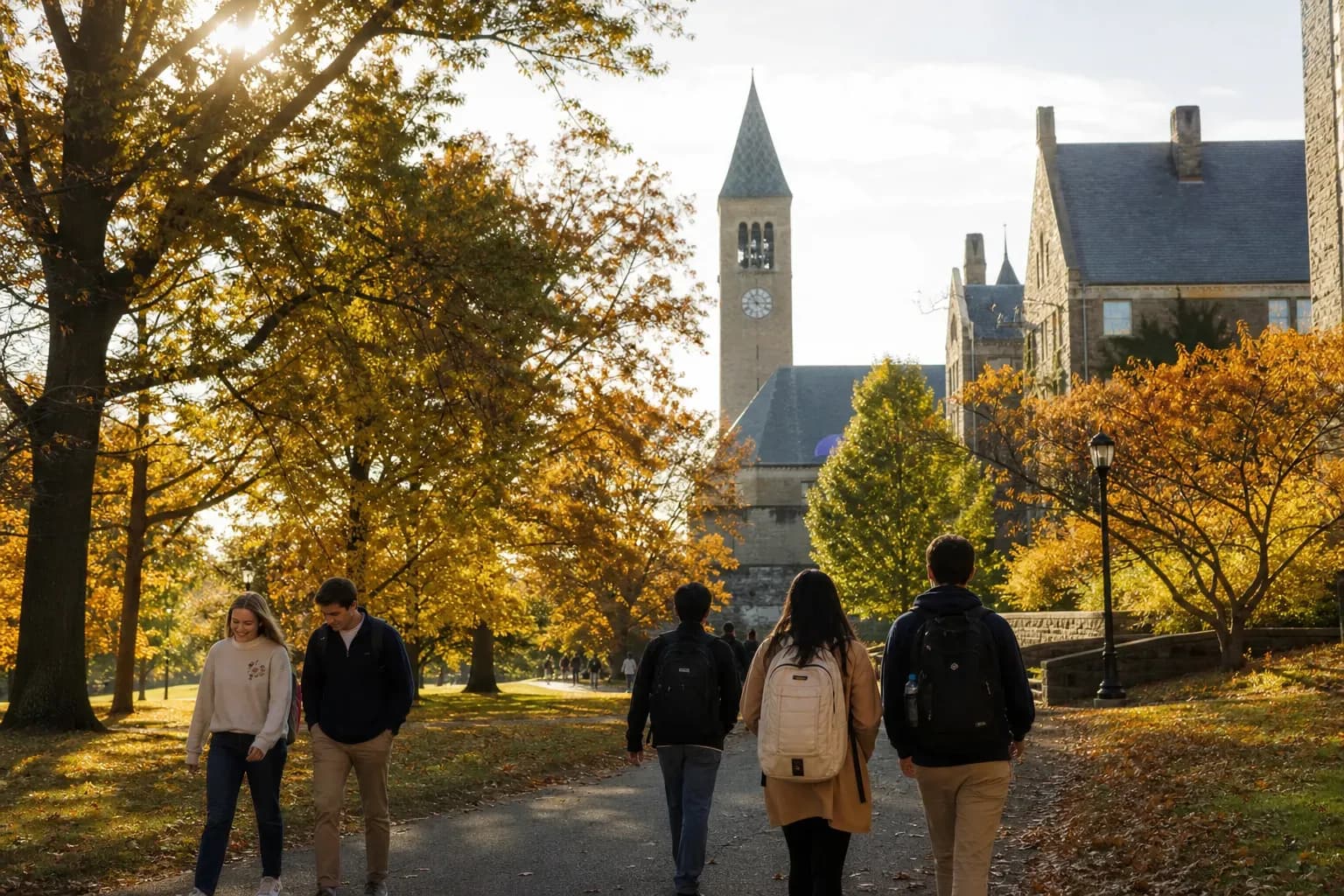
- McGraw Tower, the clock tower and highest point on campus
- Cornell Plantations, a botanical garden and nature preserve
- Statler Hotel, a real operating hotel run by students
- Cascadilla Gorge, a waterfall gorge
8. Research and Resources
Libraries
- Olin Library, the main library, plus Uris Library, open 24 hours
- 20 libraries across campus, with a total collection of more than 8 million volumes
Notable Labs / Research Centers
- Cornell Lab of Ornithology: the world's leading bird research center
- Cornell NanoScale Facility: a major hub for semiconductor research
- Cornell High Energy Synchrotron Source (CHESS)
- Cornell Tech: the Roosevelt Island campus in New York City, mainly graduate-focused but available to undergraduates during the summer
9. Notable Alumni
- Politics / Public Service: Ruth Bader Ginsburg (ILR + Law School), Janet Reno, Lee Teng-hui (former president, PhD in Agricultural Economics)
- Technology / Entrepreneurship: Bill Maris (Google Ventures), Andy Bechtolsheim (Sun Microsystems)
- Finance / Business: Sanford Weill (Citigroup), Irene Rosenfeld (Mondelez)
- Academia / Nobel Prizes: more than 60 Nobel laureates and alumni in total
- Entertainment / Literature: E.B. White (author of Charlotte's Web), Toni Morrison (Nobel Prize in Literature), Bill Nye (Bill Nye the Science Guy)
Cornell has one of the largest Taiwanese alumni communities in the Ivy League. Lee Teng-hui and Stanley Yen, an alumnus of the Hotel School, both came from Cornell.
10. Cornell Fun Facts
- There is a bear on the university seal: the mascot is the Big Red Bear.
- Cornell has the only Hotel School in the United States: at graduation, students may receive a symbolic "hotel key."
- The Suicide Bridge legend: multiple bridges on campus cross deep gorges. After past tragedies, the university has installed protective nets in recent years.
- One of Cornell's founders was Andrew Dickson White, who believed that "any study" should be open to serious inquiry. This became the origin of the university motto and was extremely progressive for its time.
- Slope Day every spring: students hold a music festival on the large Libe Slope lawn. It is Cornell's biggest party.
11. Typical Admitted Student Profile
- GPA Unweighted ~3.9+
- SAT 1480+ or ACT 33+
- 6-10 AP courses or a strong IB curriculum
- The spike must match the specific college: Hotel applicants should have hospitality or service-industry experience; CALS applicants should have life science or agriculture experience; ILR applicants should have experience with social movements or labor issues
- Essays must clearly answer "why this college." Cornell's supplemental essay places even more emphasis on fit than Harvard's does
- Recommendation letters should explain your specific academic or professional passion
Cornell is the Top 15 university that cares most about fit-to-college. For a CS applicant, applying through Arts & Sciences versus CALS requires a completely different essay strategy.
12. What Kind of Student Is Cornell Best For?
✓ Good fit:
- Students who already have a clear direction in a specific professional field, such as hospitality, agriculture, labor relations, or architecture
- Students who like large research university campuses
- Students willing to tolerate harsh winters and build a life in a small town
- Students who want the Ivy brand and hope to use ED at a school with one of the friendlier acceptance profiles
- Students with strong interest in engineering or applied science
- Students who want to study CS while reducing tuition costs, since CALS CS is a golden hack
✗ Not necessarily a good fit:
- Students who fear cold weather and dream of California sunshine
- Students who want the close teaching style of a small LAC
- Students without a clear college direction who want to "decide after getting in"; Brown is a better fit for that
- Students who need Need-Blind international financial aid, since Cornell is Need-Aware
- Students who do not want to find their own entertainment in a college town
Conclusion
Cornell is the most misunderstood Ivy. Many parents assume "Cornell is the easiest Ivy to get into." That stereotype comes from its overall 7% acceptance rate, but once you break it down, the picture changes: the Hotel School's acceptance rate is below 20%, AAP Architecture is below 10%, and the CS pathways are fiercely competitive. Every college has its own rules of the game.
If you already know you want to work in hospitality, agricultural technology, labor policy, or architectural design, Cornell may be the best place on earth. If you are still in the "I just want to attend any Ivy" stage, Cornell may leave you lost. Choosing the right college matters more than choosing the right university. That is the most important reminder Cornell offers Taiwanese families.