
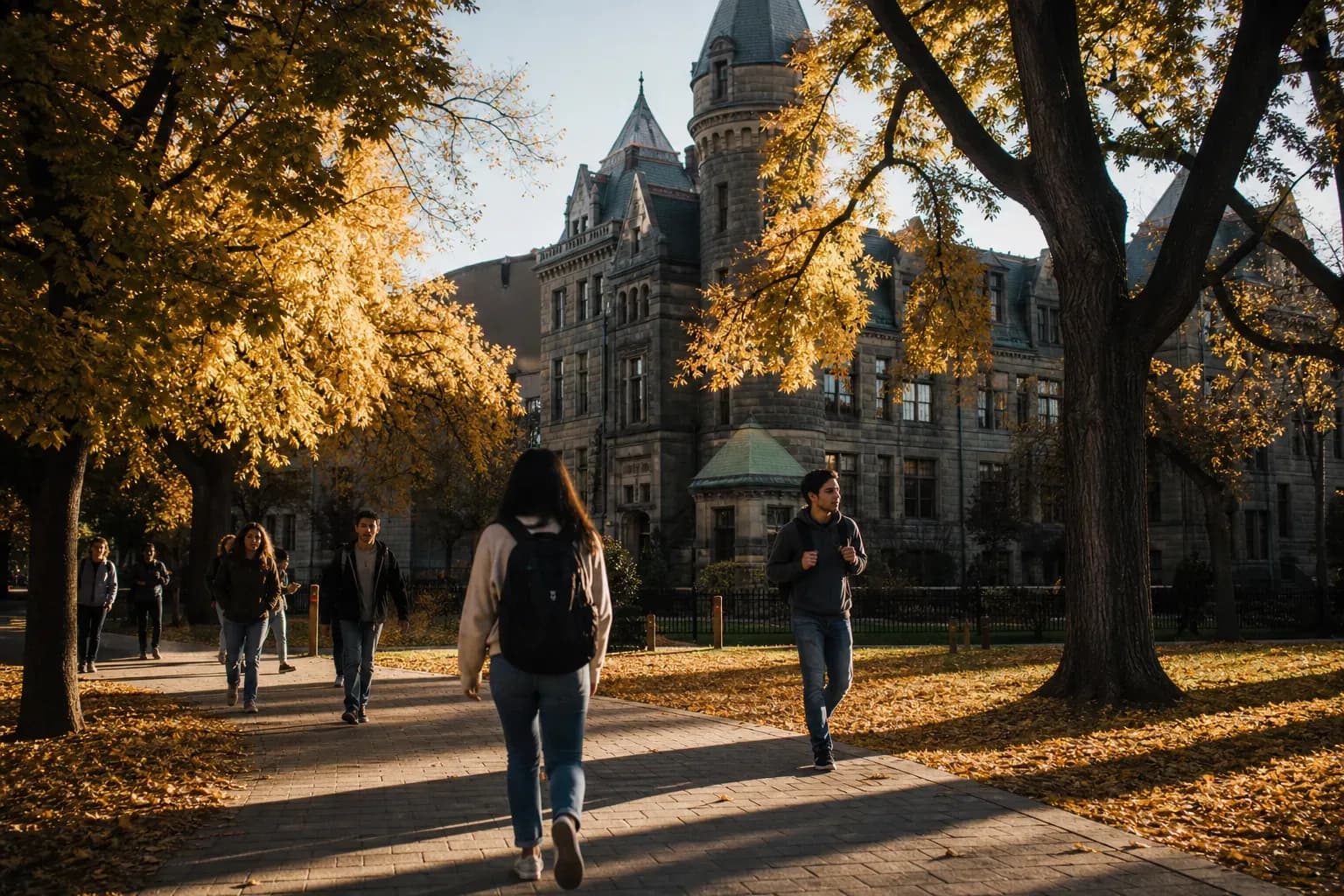
Concordia University: Montreal's Second English-Language University, John Molson School of Business, and Canada's Largest Fine Arts Faculty
Published on January 15, 2026
Concordia University is the hidden option most often overshadowed by McGill's prestige when Taiwanese families plan for study in Montreal. Its QS 2026 global ranking of #520-540 is not flashy, and its Maclean's Comprehensive ranking is #6. On paper, those numbers may look mid-tier. But Concordia's value is not in rankings. It lies in a four-part advantage: one of only two English-language universities in Montreal + tuition around 30% lower than McGill + admissions roughly three times more accessible + Canada's largest Fine Arts faculty.
To understand Concordia, remember three things first. First, Montreal's two major English-language universities are McGill and Concordia; the others are French-language institutions, including UdeM, UQAM, and Laval. Second, Concordia has Canada's first engineering school named after a woman: the Gina Cody School of Engineering. In 2018, alumna Gina Cody donated CAD $15 million for the naming, marking a milestone in engineering education. Third, the Mel Hoppenheim School of Cinema is the leading training ground for Quebec's French-language screen industry, connected to Cirque du Soleil, Ubisoft Montreal, and Denys Arcand.
Concordia is not a U15 member. The U15 refers to Canada's 15 top research-intensive universities; in Quebec, only McGill, UdeM, and Laval are included. But in the decision matrix for Taiwanese families, students with a clear direction in film, creative work, design, animation, or business who also want an urban Montreal experience will find Concordia the best value option beyond McGill.
1. Basic Information
| Item | Details |
|---|---|
| Founded | 1974 (merger of Sir George Williams College, 1873, and Loyola College, 1896) |
| Location | Montreal, Quebec (Sir George Williams main campus is in downtown Montreal) |
| Campuses | Two campuses (SGW downtown urban campus + Loyola quiet suburban campus in NDG) |
| Undergraduates | ~41,000 |
| Graduate students | ~10,000 |
| Total enrollment | ~51,000 (Montreal's second-largest university, after UdeM) |
| Student-faculty ratio | 1:25 |
| Motto | Concordia salus (well-being through harmony) |
2. World Rankings
| Ranking | Position |
|---|---|
| QS World 2026 | #520-540 |
| THE World 2025 | #501-600 |
| US News Global Universities 2024-25 | #463 |
| Maclean's Comprehensive universities | #6 |
| QS Art & Design | Global #51-100 |
| QS Communication & Media Studies | Global #101-150 |
Key point: Concordia's overall QS global ranking is ordinary, but it is global Top 100 in Art & Design. This is Concordia's core strength. Maclean's Comprehensive #6 may not look top-tier at first, but remember that the Comprehensive category includes only 15 universities, so #6 places it in the top 40% of the category.
3. Admissions Data (Fall 2024 Entry)
| Indicator | Figure |
|---|---|
| Total applicants | ~45,000 |
| Overall acceptance rate | About 70% |
| John Molson School of Business | About 32% |
| Gina Cody Engineering | About 28% |
| Faculty of Fine Arts | About 12% (strict portfolio screening) |
| Computer Science | About 25% |
| Communication Studies | About 38% |
| Yield Rate | About 40% |
Key point: Concordia's overall acceptance rate of 70% is relatively friendly among English-language universities in Montreal, much more accessible than McGill's 46%. But the Faculty of Fine Arts' seemingly low 12% acceptance rate can be deceptive. The pressure is not mainly grades, but strict portfolio screening.
International Student Standards (Direct Undergraduate Entry)
| Test / Requirement | Recommended Score |
|---|---|
| High school average (general programs) | 78%+ (IB 26+) |
| High school average (John Molson Business) | 85%+ (IB 30+) |
| High school average (Gina Cody Engineering) | 85%+ (IB 32+) |
| SAT | 1200+ (1350+ recommended for Engineering) |
| IELTS | 6.5 (6.0 in each band) |
| TOEFL iBT | 90 (Writing 22+) |
| Fine Arts | Portfolio + interview |
International Students
- International students make up about 22% of enrollment
- Students come from 150+ countries, with large numbers from China, India, Iran, and France, including French residents
- Around 15-25 Taiwanese undergraduates are admitted each year, mostly in Fine Arts, John Molson, and Engineering
4. Tuition and Financial Aid (International Student Perspective)
2024-2025 Tuition (CAD/year)
| Item | Amount |
|---|---|
| Tuition - Arts & Science | CAD $30,000-$34,000 |
| Tuition - Fine Arts | CAD $32,000-$36,000 |
| Tuition - John Molson Business | CAD $36,000-$40,000 |
| Tuition - Gina Cody Engineering | CAD $38,000-$42,000 |
| Housing (on campus or in the city) | CAD $9,000-$13,000 |
| Food + miscellaneous | CAD $7,000-$10,000 |
| Total (general program) | CAD $46,000-$57,000/year |
| Total (Business / Engineering) | CAD $54,000-$65,000/year |
Compared with McGill: International undergraduate tuition at McGill for comparable programs is CAD $52-65K. Concordia is about 30% cheaper. After Quebec's Bill 96 in 2024, international tuition in the province increased, but Concordia remains nearly one-third cheaper than McGill. Over four years, this can save CAD $50-70K, or about NTD 1.15-1.6 million.
International Student Financial Aid
- Concordia International Tuition Award of Excellence: CAD $6,000-$15,000, for high school averages of 90%+
- Faculty of Fine Arts Entrance Award: CAD $4,000-$10,000, portfolio-based selection
- John Molson Entrance Scholarship: CAD $5,000-$10,000
5. Program Structure / Signature Programs
Faculty Structure
Concordia has four faculties: Arts and Science, Fine Arts, John Molson School of Business, and Gina Cody School of Engineering and Computer Science. It offers 500+ programs.
Signature Programs
- John Molson School of Business: AACSB-accredited and one of Canada's largest business schools. Founder of the MBA Case Competition, the world's largest MBA case competition, held every January at Concordia and attracting 36 leading business schools worldwide. Its undergraduate BComm has a solid reputation on Bay Street and in Montreal's finance sector.
- Faculty of Fine Arts: Canada's largest Fine Arts faculty, with 4,000+ students. It includes the Mel Hoppenheim School of Cinema (film, animation, documentary), Department of Studio Arts (photography, sculpture, digital arts, print media), Department of Design and Computation Arts, and Department of Theatre.
- Gina Cody School of Engineering and Computer Science: Canada's first engineering school named after a woman. In 2018, alumna Gina Cody donated CAD $15 million. Software Engineering, Building Engineering, and Aerospace are its three major strengths.
- Department of Communication Studies: A major Canadian center for communication studies, with roots in the Marshall McLuhan tradition.
- Department of Computer Science: Integrated with Gina Cody Engineering. Montreal is one of Canada's AI hubs, with Mila and Element AI based locally, giving CS students many internship opportunities.
Mel Hoppenheim School of Cinema (The University's Crown Jewel)
- The leading training base for Quebec's French-language film and television industry
- A major talent pipeline for Cirque du Soleil and Ubisoft Montreal
- Alumni and connections include major Canadian filmmakers such as Denys Arcand, whose works include The Decline of the American Empire and the Oscar-winning The Barbarian Invasions, and Atom Egoyan, who completed some credits there
- The undergraduate BFA Film Production admits only about 60 students and is extremely difficult to enter
Two-Campus System
- Sir George Williams Campus (SGW, main campus): An urban campus in downtown Montreal, directly connected to Guy-Concordia Metro station. The business school, engineering school, arts and science programs, and graduate programs are mainly based here. The buildings are modern and woven into Montreal's urban fabric.
- Loyola Campus: A quiet, traditional campus in NDG, Notre-Dame-de-Grace, on the former Loyola College site dating to 1896. Some Faculty of Fine Arts departments, Communication, Journalism, and Sciences are based here. The architecture has a historic character.
6. Campus Culture / Institutional Personality
Concordia's campus culture can be summarized in one sentence: creative, diverse, left-leaning, and streetwise. Compared with McGill, its student body is more working-class, more internationally diverse, and more artistic, creative, and action-oriented. Concordia students jokingly say, "We are the children of Montreal's streets." The boundary between campus and downtown Montreal is blurred, with cafes, bars, galleries, and music venues right outside the university doors.
Campus Legends
- Sir George Williams Affair (1969): Concordia students occupied the SGW building's computer center to protest racial discrimination. It became one of the largest student protests in North America, resulting in CAD $2 million in damaged computer equipment and 97 arrests. It is a key chapter in Canadian civil rights history.
- Concordia was the first Canadian university to establish a Gender Studies Department in 1971.
- Faculty of Fine Arts student work: Student work is frequently shown at the Montreal Mural Festival, Nuit Blanche, and FNC film festival. The campus is part of Montreal's active art scene.
Student Clubs
- 250+ clubs
- CSU (Concordia Student Union) is the student union
- Cinema Politica: A global documentary screening network started by Concordia Cinema students
- Taiwanese student communities connect through Asian Heritage Month activities
Sports Culture
- Varsity teams are called the Stingers, represented by a bee and yellow-black colors
- One of the notable U Sports programs in Canadian university athletics, with strong men's and women's hockey and women's soccer
- Sports culture is moderate. Concordia's culture emphasizes academics and creativity more than athletics
7. Location / Campus Environment
City Positioning
The SGW main campus sits in the heart of downtown Montreal. Guy-Concordia Metro station connects directly to campus, with Sainte-Catherine, Montreal's main commercial street, a 5-minute walk away, Old Montreal 10 minutes away, and McGill's campus 15 minutes away. It is Canada's only university whose campus is fully integrated into a downtown commercial district. McGill is also downtown, but it still feels like an enclosed campus at the foot of the mountain.
Montreal is Canada's second-largest metropolitan area and North America's third-largest French-speaking city, after Paris and Kinshasa. The cost of living is 30-40% lower than Toronto / Vancouver. A one-bedroom apartment costs CAD $1,200-$1,800/month, far below Toronto's $2,200-$2,800. The metro system has four lines and broad coverage.
Climate
- Winter: -15°C to -5°C, with frequent heavy snow from January to March; harsher than Toronto
- Summer: 22-28°C, humid and pleasant, with many Montreal summer festivals, including Jazz Fest, Just for Laughs, and FrancoFolies
- Spring and fall: short, with spectacular maple leaves in October
Campus Landmarks
- Henry F. Hall Building (H Building): SGW's main academic building, 13 stories
- EV Building: Integrated Engineering & Visual Arts building
- John Molson School of Business Building: MB Building, completed in 2009 and considered a contemporary architectural landmark
- Loyola Chapel: Loyola Campus, built in 1933 and recognized as a historic site
- D.B. Clarke Theatre: Main performance hall for the Faculty of Fine Arts
8. Research and Resources
Libraries
- 2 branches: Webster Library at SGW and Vanier Library at Loyola, with 2 million volumes
- Webster Library is open 24 hours during final exam periods
Notable Research Centers
- Mel Hoppenheim School of Cinema (film / animation research)
- Hexagram Network (cross-disciplinary art / technology research, jointly operated with UQAM)
- Centre for Engineering in Society
- Concordia Institute for Information Systems Engineering (CIISE)
- Mila collaboration (research projects with UdeM, McGill, and the Mila AI institute)
9. Notable Alumni
- Literature: Mordecai Richler, author of The Apprenticeship of Duddy Kravitz and Barney's Version; Leonard Cohen, poet / singer / Hallelujah, BA from Loyola College / Concordia in 1955
- Entertainment: Mike Myers, Wayne's World, Austin Powers, Shrek voice actor; Brent Butt, creator of Corner Gas; Pat Mastroianni
- Film: Denys Arcand, The Decline of the American Empire and Oscar-winning Best Foreign Language Film The Barbarian Invasions; Vincent Massey
- Business: David Sobey, CEO of Sobeys Foods; Gina Cody, engineer and 2018 donor behind the naming of Gina Cody Engineering
- Architecture / Design: Phyllis Lambert, founder of the Canadian Centre for Architecture and member of the Bronfman family
Concordia's broadest alumni influence is in Montreal's creative industries and the history of Canadian literature, film, and television. Leonard Cohen is the spiritual icon of Concordia's institutional history, while Mike Myers is one of Canada's best-known representatives in Hollywood.
10. Concordia Trivia
- The Sir George Williams Affair was one of North America's largest student protests: In February 1969, Concordia students occupied the SGW computer center for 13 days to protest racism by Biology professor Perry Anderson toward Caribbean students. Police intervention led to CAD $2 million in computer damage and 97 arrests. The incident directly influenced the formation of Canada's 1971 multiculturalism policy.
- Leonard Cohen completed his BA at Loyola College: He graduated in 1955 and later became one of Canada's national literary and musical icons. Hallelujah, Suzanne, and Famous Blue Raincoat were all created in Montreal. Concordia has a Leonard Cohen memorial on Loyola Campus.
- Gina Cody was Concordia's first female PhD in Engineering (1989 PhD in Building Engineering). In 2018, she donated CAD $15 million to name the engineering school, making it Canada's first engineering school named after a woman. She said, "I want every young woman to walk through these doors and know: this is your place too."
- The Mel Hoppenheim School of Cinema is known inside Cirque du Soleil and Ubisoft Montreal as a talent source. About 30% of Cirque du Soleil visual designers and Ubisoft Montreal game designers / animators are Concordia alumni.
- Concordia's varsity teams are called the Stingers: The name evokes a bee, with yellow-black colors, and suggests being small, sharp, and highly competitive. Concordia Stingers Women's Hockey is a strong U Sports program.
11. Typical Admitted Student Profile
- High school average after conversion: 78-88%+ (IB 28+, A-Level BBB+, top 35% of Taiwanese high school class)
- SAT 1200+ (1350+ recommended for Engineering)
- IELTS 6.5+ / TOEFL 90+
- Faculty of Fine Arts requires a portfolio: 12-20 works + Artist Statement + interview
- John Molson Business: supplementary essay + leadership evidence
- Engineering: math and science performance + competition / project experience
- Unlike the U.S. Common App, Concordia is not asking for a life story. It values academic fit plus portfolio / motivation
- Concordia is friendly to Taiwanese IB / A-Level / top 35% high school students. It is roughly three times easier to enter directly than McGill and is the highest-value English-language option in Montreal
12. What Kind of Student Is Concordia Right For?
✓ Good fit:
- Students who want Montreal but cannot get into McGill; Concordia is the next-best English-language choice in the city
- Students with a clear direction in creative fields, film, animation, design, or Studio Arts
- Students who want John Molson School of Business plus networking in Montreal's finance / startup circles
- Families with a budget of CAD $46-65K/year, around 30% lower than McGill
- Students who like urban Montreal life, street-level creative culture, and a multilingual environment
- Students who are not bothered by commuter campus culture and can integrate into Montreal city life independently
✗ Not necessarily a good fit:
- Students who want a close-knit peer community and strong school spirit; choose Queen's / Western / McGill instead
- Purely research-oriented students aiming for a PhD; U15 universities such as McGill / U of T are more suitable
- Students who want an American-style college town experience; Concordia is thoroughly urban
- Students who do not know basic French and do not want to learn it; daily life in Montreal is about 60% French, and although Concordia is fully English on campus, the city outside is French-speaking
- Students planning to obtain Quebec PR immediately after graduation but not planning to learn French; Quebec immigration almost always requires French
13. Advantages for Studying in Canada + Immigration Pathways
Concordia's value within Canadian immigration pathways should be understood through two routes: Quebec's internal pathways, PEQ / PSTQ, almost always require French, while the federal Express Entry pathway is completely unaffected by Quebec law. This is the strategy Concordia students most often overlook.
PGWP (Post-Graduation Work Permit)
After completing a Concordia degree program of at least 8 months, graduates can apply for a 3-year Open Work Permit, regardless of major. The language requirement is IELTS General CLB 7, or 6.0 in each band. Taiwanese students with IELTS 6.5-7.0 usually meet the threshold. The PGWP is valid across Canada. Even if you graduate from Concordia, you can use the PGWP to work in Toronto, Vancouver, or any other province.
Express Entry / CEC (Federal Pathway: The Main Route for Concordia Students)
- In 2026 Q1, CEC cut-offs were about 521-547 for general rounds
- STEM category cut-offs were only 481-524, applicable to Gina Cody Engineering / CS students
- French category cut-offs were 379-428. If Concordia students learn French while in Montreal and take the TEF to reach NCLC 7, they gain 50 CRS points and enter the French-language draw pool, an underrated shortcut
- Age 27, single, Concordia master's degree + 1 year of Canadian work experience + IELTS 7.0: CRS around 510-530
Quebec PEQ + PSTQ (Quebec Internal Pathway: High French Threshold)
Because of Quebec's 2020 rule changes and 2024 Bill 96:
- PEQ (Programme de l'experience quebecoise): Since 2020-07, it has added 12-24 months of Quebec work experience + French speaking B2 (CCQ NCLC 7)
- PSTQ (Programme de selection des travailleurs qualifies): Replaced PRTQ on 2024-11-29. All streams require oral French at B2 or above
What this means for Concordia English-language graduates: If you do not commit to learning French, Quebec's internal immigration pathways are almost closed. The most practical choice for Concordia students is to move to Ontario / BC after graduation, use the PGWP, and pursue federal EE / provincial PNP. This route is completely unaffected by Bill 96.
Impact of the 2024-2025 International Student Cap
Because of Bill 96 and Quebec's 2024 TFEE legislation, Quebec reduced international student study permit quotas by 20% and increased international tuition by 33%. As an English-language research university, Concordia's master's and doctoral students are relatively protected, but the undergraduate cap has a clear impact. Taiwanese students applying for 2025-2026 should begin PAL / CAQ preparation 4-6 months earlier.
Value Benchmark Against Comparable U.S. Schools
| Item | Concordia | Comparable U.S. schools (Northeastern / Pratt) |
|---|---|---|
| QS 2026 | #520-540 | Northeastern #54 / Pratt unranked |
| Tuition (international BComm) | CAD $40K (USD $29K) | USD $63-75K |
| Fine Arts scale | Canada's largest | Comparable tier to Pratt Institute / RISD |
| Post-graduation stay pathway | PGWP 3 years + federal EE / out-of-province PNP | OPT 1-3 years + H-1B lottery |
| Permanent residence timeline | 2-4 years (master's + 1 year + EE) | 5-10 years |
Concordia's Fine Arts + Film + Design scale is actually larger than Northeastern and Pratt combined, while tuition is only about half.
Conclusion
Concordia is right for Taiwanese families whose priority is: "We want Montreal city life + creative / design / film / business programs + tuition that is not too high + acceptance of the federal EE pathway, not necessarily Quebec PR." It is not McGill's old-guard U15 prestige, enclosed mountainside campus, and high international ranking. It is more like Canada's version of NYU + Pratt: urban, creative, streetwise, and equally serious about business and film.
Choosing Concordia means accepting several realities. First, it is not in the U15. Its academic halo is weaker than McGill's, and Taiwanese parents or relatives will react far more coolly to the name "Concordia" than to "McGill." Second, after Bill 96, Quebec's internal immigration pathways almost always require French. If you do not learn French, the best strategy after graduation is usually to move to ON / BC and use the PGWP. Third, the campus is integrated into downtown Montreal and does not offer an American-style close-knit peer circle. Your peer network is the entire Montreal creative industry.
But if your child is the kind of student who, at 18, already knows they want to enter the Mel Hoppenheim School of Cinema and make films inspired by Denys Arcand; or wants to study at Gina Cody Engineering, write code, and dream of making games at Ubisoft Montreal; or wants to enter John Molson Business and start a company from Montreal, Concordia is one of the best investments on earth for a ticket into Montreal's creative industries. Mel Hoppenheim's films, Ubisoft's games, and Cirque du Soleil's stages are three lifelines of Montreal's creative economy, and all of them run through Concordia alumni. McGill's academic prestige cannot give you that.
Sources
- Concordia University — Undergraduate Admissions, International Students (accessed 2026-05-14) https://www.concordia.ca/admissions/undergraduate/international.html
- Maclean's University Rankings 2025 (accessed 2026-05-14) https://www.macleans.ca/education/university-rankings/
- QS World University Rankings 2026 (accessed 2026-05-14) https://www.topuniversities.com/world-university-rankings
- MIFI Quebec — PSTQ and PEQ Pathways (accessed 2026-05-14) https://www.quebec.ca/en/immigration/permanent/skilled-workers/regular-skilled-worker-program
- Dr. G. Academy internal file 03_Canada_Visa_Strategy.md (2026-05-02)