
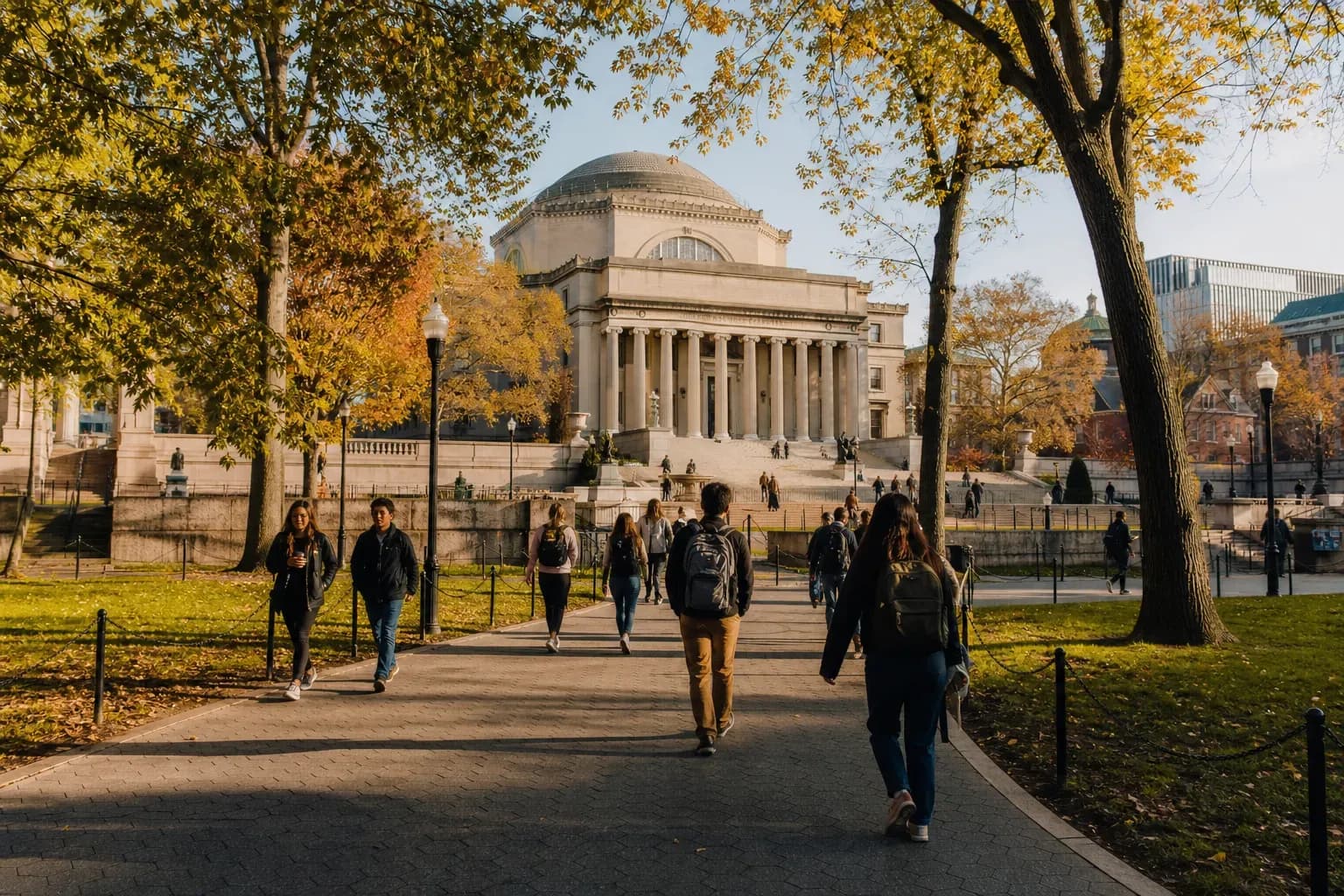
Columbia University: Core Curriculum, the Heart of New York City, and the Most Urban Ivy
Published on November 5, 2025
Tied for #13 among U.S. national universities in US News, ranked in the world’s top 25 by QS, and located in Morningside Heights in northwestern Manhattan, Columbia is the only Ivy League university set in the core of a world-class metropolis. Brown is in a small city, Cornell is in the countryside, Princeton is in a college town. Only at Columbia do you step out of the campus gates and find yourself on Broadway.
Columbia can be summed up in one sentence: “Studying the oldest books in the world’s fastest city.” You will read Homer, Aristotle, Saint Augustine, and Kant in the Core Curriculum, then walk out of class and reach Wall Street in 30 minutes by subway, the United Nations in 20 minutes, and Michelin-starred restaurants in 5 minutes. That contrast is Columbia.
1. Basic Information
| Item | Details |
|---|---|
| Founded | 1754 (the fifth-oldest institution in the U.S.; originally King’s College) |
| Location | New York City, NY (Morningside Heights, Upper West Side, Manhattan) |
| Campus | About 36 acres (main campus) |
| Undergraduates | ~9,000 (Columbia College + SEAS + GS) |
| Graduate Students | ~25,000+ |
| Student-Faculty Ratio | 1:6 |
| Motto | In lumine Tuo videbimus lumen (“In Thy light shall we see light”) |
2. World Rankings
| Ranking | Placement |
|---|---|
| US News National Universities 2025 | #13 |
| QS World 2025 | #23 |
| THE World 2025 | #17 |
| US News Journalism (J-School) | #1 |
| US News Business (Pre-MBA Undergrad) | Top 5 |
| US News Engineering (SEAS) | Top 15 |
3. Admissions Data (Class of 2028)
| Metric | Figure |
|---|---|
| Applicants | ~60,000 |
| Admitted Students | ~2,360 |
| Overall Acceptance Rate | About 3.9% |
| ED Acceptance Rate | ~11% |
| RD Acceptance Rate | ~3% |
| Yield Rate | ~71% |
Columbia’s overall acceptance rate is close to Harvard’s, making it the second-hardest Ivy to enter after Harvard. ED offers a significant advantage, but applicants need to be clear about whether they are applying to Columbia College (liberal arts and sciences) or SEAS (engineering).
SAT/ACT Median Scores
| Test | 25th percentile | Median | 75th percentile |
|---|---|---|---|
| SAT | 1510 | 1555 | 1580 |
| ACT | 34 | 35 | 35 |
International Students
- International students make up about 16% of the student body, one of the highest proportions in the Ivy League
- Students come from 100+ countries
- About 5-10 students from Taiwan are admitted each year
4. Tuition and Financial Aid
2024-2025 Costs
| Item | Amount |
|---|---|
| Tuition | USD $68,400 |
| Housing | USD $15,946 |
| Food | USD $7,180 |
| Personal + Misc | USD $4,500 |
| Total | USD $96,000+ |
Columbia has the highest total cost among the Ivies because housing in New York City is expensive.
Need-Based Aid
- Family income < $150,000: full tuition covered (new policy starting in 2024, aligning more closely with Princeton)
- Family income < $66,000: tuition + housing + meals fully covered
- Need-Blind for international students (since 2022)
- Average aid: USD $69,000/year
- No-Loan Policy
Columbia only announced need-blind admissions for international students in 2022, but now that the policy is in place, Taiwanese families can apply for aid with greater confidence.
5. Academic Structure / Signature Programs
Three Undergraduate Schools
- Columbia College (CC): the traditional undergraduate liberal arts college, 4,500 students
- The Fu Foundation School of Engineering and Applied Science (SEAS): engineering, 1,700 students
- School of General Studies (GS): for nontraditional-age students, such as those with multiple gap years or military veterans
Undergraduate Majors
- CC offers 80+ majors
- Top 5 popular majors:
- Computer Science
- Economics
- Political Science
- Financial Economics
- History
Core Curriculum (Columbia’s Signature)
Columbia’s Core Curriculum is the oldest and strictest core requirement system in the United States. All Columbia College students must complete the following:
- Literature Humanities (Lit Hum): reading Homer, the Bible, Shakespeare, Dostoevsky, and more
- Contemporary Civilization (CC): reading Plato, Aristotle, Locke, Marx, Freud, and others
- Art Humanities
- Music Humanities
- Frontiers of Science
- University Writing
- Global Core
- Language requirement
- Physical education requirement (yes, one of the few Ivies that still requires PE)
The Core is Columbia’s cultural signature. All CC students have read the same books, creating a shared language among alumni. SEAS students complete a streamlined version of the Core.
Signature Systems
- Columbia-Juilliard Exchange: a joint program with Juilliard
- Combined Plan: 3+2 Engineering dual-degree program
- Barnard College: Columbia’s women’s sister college, independent but with shared academic credit
6. Campus Culture / Institutional Personality
Columbia’s personality is urban elite + classical learning + political consciousness. Students are deeply engaged in activism, from the 1968 anti-Vietnam War protests to today’s Gaza protests. They care about global issues and the arts. The biggest difference between Columbia students and students at other Ivies is this: they treat the campus as part of the city, not as a refuge from it.
Greek Life
- About 10-15% participate, lower than at many other Ivies
- New York City is far more appealing than the frat house, so students often spend weekends in Manhattan rather than on campus
Athletics Culture
- Ivy League conference
- Not an athletic powerhouse, but fencing and rowing are well known within the Ivy League
- The Columbia vs Cornell football game is a tradition
Student Personality
Columbia students are the most cosmopolitan, most worldly, and most precocious in the Ivy League. Many start interning at the United Nations, banks, or media companies from their first days of college.
7. Location / Campus Environment
Urban Positioning
Columbia’s main campus is in Morningside Heights, along Broadway between 110th Street and 125th Street. The campus is a 5-minute walk from the northern edge of Central Park, 15 minutes by the 1 train to Times Square, and 30 minutes to Wall Street. The campus is surrounded by student housing owned by Columbia, forming a hybrid of “campus + neighborhood.”
Climate
- Winter: -3°C to 5°C, with snow, but milder than Boston
- Summer: 25-32°C, humid and hot
- Spring and fall are pleasant
Campus Landmarks
- Low Memorial Library (administrative center + iconic library facade)
- Butler Library (the true main library)
- College Walk (the 116th Street pedestrian campus corridor)
- Alma Mater statue (an image associated with the university seal)
- Rockefeller Apartments
8. Research and Resources
Libraries
- Butler Library holds 2 million volumes and is open 24 hours
- 22 libraries across the university, with a total collection of 13 million volumes
Notable Labs / Research Centers
- Earth Institute / Climate School: a global leader in climate research
- Mailman School of Public Health: top 5 in public health
- Columbia Journalism School: first in the world for journalism research and education; administrator of the Pulitzer Prize
- Lamont-Doherty Earth Observatory: earth sciences
- Center on Global Energy Policy
9. Notable Alumni
- Presidents / Politics: Barack Obama (CC), Theodore Roosevelt, Franklin D. Roosevelt (briefly attended)
- Technology and Entrepreneurship: Larry Page (considered Columbia but chose Stanford), Robert Kraft, Henry Kravis (KKR)
- Finance / Business: Warren Buffett (MS Business), Benjamin Graham, Jeff Bezos (high-achieving CC student) -- both Warren Buffett and Jeff Bezos came through Columbia!
- Academia / Nobel Prizes: 100+ Nobel laureates in total
- Entertainment / Literature: Jake Gyllenhaal, Julia Stiles, Federico García Lorca (attended), Allen Ginsberg, Jack Kerouac
Columbia alumni are defined by their range across fields. One university can produce Obama, Buffett, Bezos, and the poets of the Beat Generation because New York City itself is that kind of melting pot.
10. Columbia Fun Facts
- There is a miniature Roman Pantheon on campus -- Low Library’s dome is modeled after the Pantheon in Rome.
- King’s College was founded in 1754: Columbia is 22 years older than the United States and suspended operations during the Revolutionary War.
- The Pulitzer Prize is awarded by Columbia: it has been announced every May since 1917.
- There are secret tunnels beneath campus: Columbia has an old underground tunnel system. Students pass down stories about it, though few have actually entered.
- Orgo Night happens every year: on the night before the organic chemistry final, the Marching Band storms Butler Library and disrupts studying with instruments. It is a traditional ritual, though the university has restricted it in recent years.
11. Typical Admitted Student Profile
- GPA Unweighted ~3.95+
- SAT 1510+ or ACT 34+
- 8-12 AP courses or a strong IB curriculum
- A spike leaning toward the humanities and social sciences: debate team, Model UN, writing competitions, activist organizations, arts
- Essays must show a genuine desire for New York + the Core Curriculum. Columbia’s supplemental essays directly ask what books you have read and why you want to study the Core
- Recommendation letters should explain your analytical and writing abilities
Columbia admits “the kind of person who would read Plato on the New York subway”: someone with both intellectual depth and an urban sensibility.
12. What Kind of Student Is a Good Fit?
✓ Good fit:
- Students drawn to big-city life in New York
- Students who enjoy reading classic primary texts and are not afraid of the Core Curriculum workload
- Students interested in Journalism, Finance, Public Policy, or the Arts
- Students already used to a major-city pace and able to manage themselves in Manhattan
- Students with a strong international perspective and cross-cultural interests
- Students who do not need a self-contained “little campus world”
✗ May not be the best fit:
- Students who want a traditional college-town experience; Princeton is a better match
- Students who fear urban noise or the subway
- Students who want complete freedom in course selection; Brown is a better match
- Students pursuing pure hardcore STEM; MIT or Caltech may make more sense
- Students who dislike reading large volumes of classical texts
Conclusion
Columbia is the least tranquil Ivy. Campus protests, the New York subway, Wall Street internship interviews, midnight coffee at Butler Library: the rhythm of four years here is twice as fast as at many other Ivies. If you can handle that pace, Columbia can turn you into a global citizen. If you cannot, Princeton or Dartmouth may be a better fit.
Columbia’s value is not in the campus alone, but in the equation campus + New York = education. The Core Curriculum gives you a classical skeleton; New York gives you modern flesh and blood. Remove either one, and it is no longer Columbia. If your child studies with real intellectual fire and loves the pulse of a major city, Columbia is the Ivy that may fit best.