
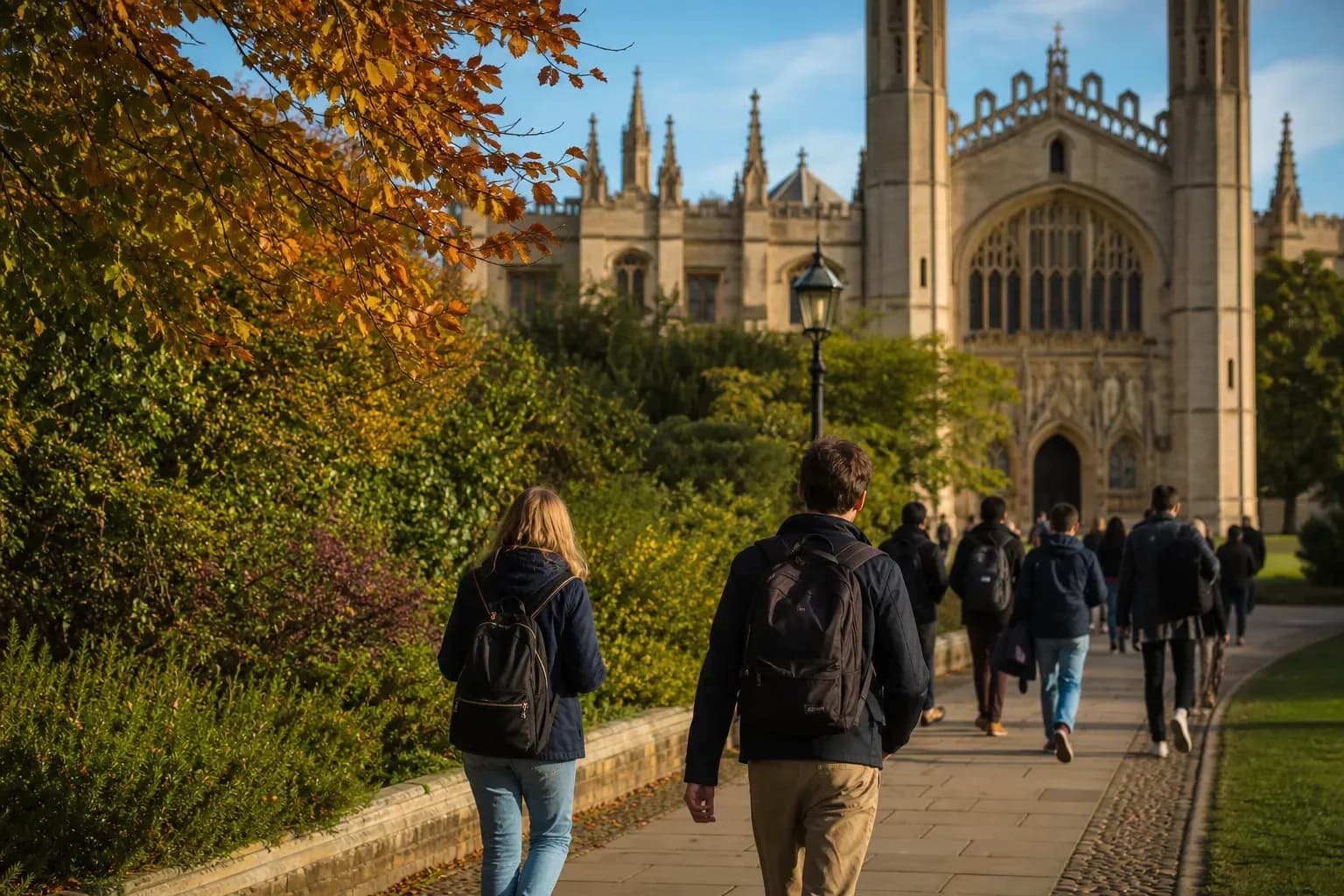
University of Cambridge: 800 Years of Collegiate Tradition, One-to-One Supervision, and the Rigorous Tripos System
Published on December 13, 2025
Ranked #6 globally in QS 2026 and consistently #1 in the UK by the Complete University Guide, Cambridge is one of the few universities in the world that has “barely changed in 800 years.” Its 31 colleges, one-to-one Supervision system, and Tripos degree structure may sound like relics of another era, but they remain the operating core of Cambridge education every day. If your idea of university is “discussing a problem over sherry with a Fields Medal-winning mathematician in a college senior combination room,” Cambridge is the closest place on Earth to that image.
Cambridge is not a “modern research megamachine.” It is a living fossil of classical elite education. While freshmen at other universities sit in 200-person lecture halls taking notes, a Cambridge fresher may be in a supervisor’s office discussing this week’s essay one-on-two with a Nobel laureate. To understand Cambridge, start with one thing: you do not simply “get into Cambridge.” You get into Trinity / King’s / St John’s. Your college identity lasts for life.
1. Basic Information
| Item | Details |
|---|---|
| Founded | 1209 (the second-oldest university in the English-speaking world) |
| Location | Cambridge, England (about 1 hour by train north of London) |
| Campus | Colleges spread throughout the city (no centralized campus) |
| Undergraduates | ~12,800 |
| Postgraduates | ~11,200 |
| Number of colleges | 31 Colleges |
| Group affiliation | Russell Group + Ancient University |
| Motto | Hinc lucem et pocula sacra (From here, light and sacred draughts of knowledge) |
2. World Rankings
| Ranking | Position |
|---|---|
| QS World 2026 | #6 |
| THE World 2026 | #3 |
| Complete University Guide 2026 (UK) | #1 |
| Guardian University Guide 2026 (UK) | #1 |
| QS Mathematics | #2 |
| QS Engineering – Mechanical | #3 |
| THE Arts & Humanities | #5 |
3. Admissions Data (2025 Entry)
| Indicator | Figure |
|---|---|
| Applicants | ~22,800 |
| Admitted students | ~3,400 (including firm and reserve offers) |
| Overall acceptance rate | Around 17% |
| International applicant acceptance rate | ~9% |
| Acceptance rate for popular subjects (CS / Econ / Medicine) | < 10% |
| Yield Rate | ~85% |
Typical A-Level / IB Offers
| Subject area | Standard A-Level offer | Standard IB offer |
|---|---|---|
| Mathematics / Engineering / NatSci | A*A*A (including Grade 1 in both STEP 2 and STEP 3) | 41-42 points (HL 776) |
| Humanities | A*AA | 40-41 points |
| Medicine | A*A*A (including Chemistry + 1 science subject) + UCAT | 41 points (HL 776) |
| Economics | A*A*A (including Math) | 41 points (including HL 776 with HL Math) |
International Students
- International students make up around 24% of the undergraduate population
- Students come from 150+ countries
- Taiwan typically has around 3-6 admits per year (including students from local high schools, IB, A-Level, and Foundation pathways)
- Applications must go through UCAS + Cambridge’s own My Cambridge Application (additional written materials)
4. Tuition and Living Costs
2025-2026 International Tuition Fees (by Subject Band)
| Band | Example subjects | Tuition (per year) |
|---|---|---|
| Band 1 | Humanities, Law, Econ, Math | £28,768 |
| Band 2 | Architecture, Geography, MML | £33,972 |
| Band 3 | NatSci, Engineering, CS, MusT | £39,162 |
| Band 4 | Pre-clinical Medicine, Veterinary | £45,684 |
| Band 5 | Clinical Medicine (after Year 3) | £74,310 |
College Fee (Additional)
| Item | Amount |
|---|---|
| College Fee (additional payment to the college for international students) | £9,000-12,500/year |
| Accommodation + meals (within college) | £8,000-11,000/year |
| Miscellaneous expenses | £2,500/year |
| Total (including tuition) | Around £50,000-65,000/year |
Graduate Route Visa
After graduation, students may apply for the Graduate Route, which grants 2 years of work permission in the UK after a master’s / bachelor’s degree and 3 years after a PhD, with no employer sponsorship required. This is the first pathway for Cambridge graduates who want to remain in the UK.
Scholarships
- Cambridge Trust Scholarships: the main scholarship source for international students, with both full and partial awards available
- Gates Cambridge Scholarship: full funding at postgraduate level (including living costs + airfare), awarded to only around 80 students worldwide each year
- Chevening / GREAT Scholarship: UK government awards, requiring separate applications
5. Academic Structure / Flagship Programs
Tripos System
Cambridge’s degree structure is called the Tripos (originating from a three-legged stool), dividing degrees into three stages: Part IA, IB, and II. Each Tripos is a subject group. Students enter a chosen Tripos from Year 1, with one major exception: the Natural Sciences Tripos (NST). NST students can take 4 STEM subjects in Year 1, narrow that to 2-3 in Year 2, and then specialize in 1 subject in Year 3.
Flagship Programs
- Natural Sciences Tripos (NST): a flexible integrated major across physics / chemistry / biology / materials / earth sciences, and one of Cambridge’s most distinctive programs
- Mathematical Tripos: includes the famous Part III (Master of Mathematics), among the world’s strongest pure mathematics training programs
- Computer Science Tripos: ranked #1 in the UK for CS; Turing and Hinton (the “godfather of deep learning”) both came through Cambridge
- Land Economy: a rare interdisciplinary program combining land / environment / law / economics, unique to Cambridge
- HSPS (Human, Social and Political Sciences): an integrated program covering anthropology / politics / sociology
Supervision System (the Core of Cambridge Education)
Supervisions take place 1-2 times per week in a one-to-one or one-to-two format, led by a fellow or senior PhD student. Students submit an essay or problem set in advance, then face close, line-by-line questioning during the supervision. This is not a lecture; it is a hybrid of “private tutoring × academic debate.” Cambridge students receive around 50-70 hours of supervision per year, making Cambridge, alongside Oxford, one of the only universities in the world still running this system at scale.
Collegiate System
In addition to being admitted by your subject, you are also assigned to a college (1 of 31). Your college determines your:
- Accommodation (most colleges house first-year students)
- Dining hall / library / Chapel
- Supervision tutor and director of studies
- Social circle (college sports, formal dinners, balls)
The 31 colleges differ significantly: Trinity (wealthiest and most elite), King’s (liberal and artistic), St John’s (traditional and elegant), Churchill (strong in STEM), Newnham (women’s college), Hughes Hall / Wolfson (mature students).
6. Campus Culture / Institutional Personality
Cambridge’s character can be summed up in one sentence: quiet competition, classical elegance, and intellectual intensity. Students may not be as eager as American students to tell you they are “at Cambridge,” but their Part III dissertation may already have rewritten a mathematical theorem.
Formal Hall
Formal Hall, held 1-3 times per week, is a formal college dinner requiring academic gowns and serving 3-4 courses. It is one of the central rituals of Cambridge college life. Rules differ by college, and the evensong + formal experience at King’s College is among the most beautiful in the UK.
May Week (Actually in June)
After exams, “May Week” (despite taking place in June) is the most festive week of the Cambridge year. Colleges take turns hosting May Balls (from 9 p.m. to 6 a.m., with £200-400 entry fees), alongside the Suicide Sunday boat races and college garden parties.
Sports and Societies
- Boat Race (against Oxford): held on the Thames every March-April, this is one of the oldest rivalries between Cambridge and Oxford
- Cambridge Union Society: a debating society founded in 1815, associated with figures such as Churchill and Stephen Fry
- Footlights: Cambridge’s comedy society, whose alumni include Hugh Laurie, Stephen Fry, and John Cleese
7. Location / Campus Environment
City Profile
Cambridge is a small city of 140,000 people, about 50-75 minutes by train from London King’s Cross. The entire city centre is almost occupied by the university, with colleges spread along both sides of the River Cam. Cycling is the main form of transport. Cambridge is also the UK’s second-largest technology cluster (Cambridge Silicon Fen), with ARM, AstraZeneca, Microsoft Research, and DeepMind all maintaining a presence.
Climate
- Winter: -1°C to 8°C, with occasional snow
- Summer: 13°C to 22°C, comfortable
- Cloudy and rainy throughout the year, with autumn being the most beautiful season
Campus Landmarks
- King’s College Chapel (Gothic architecture, construction began in 1446)
- Trinity College Great Court (where Newton is said to have measured the speed of light)
- Mathematical Bridge (wooden bridge at Queens’ College)
- Fitzwilliam Museum
- River Cam punting routes
8. Research Resources
Libraries
- Cambridge University Library (UL): a legal deposit library with 9 million volumes
- Every college has its own library (the oldest is the Wren Library at Trinity, which holds Newton’s manuscripts)
- Subject-specific libraries: CS, Math, Law, and other departments each have their own research libraries
Notable Laboratories / Research Centers
- Cavendish Laboratory: a legend in physics, associated with 29 Nobel Laureates (the electron, neutron, and DNA structure were all discovered here)
- Laboratory of Molecular Biology (LMB): a world-class biomedical research base; Watson & Crick discovered the DNA double helix here
- Computer Laboratory: a UK hub for CS, where EDSAC, the world’s first stored-program computer in practical operation, was developed
- Cambridge Centre for AI in Medicine
9. Notable Alumni
- Science / Nobel Prizes: Isaac Newton, Charles Darwin, Stephen Hawking, Alan Turing, Francis Crick, James Watson (121 Nobel Laureates, the highest number in the world)
- Politics / Royal Family: Prince Charles (now King Charles III), Prince William, 15 British prime ministers
- Literature / Academia: Lord Byron, Vladimir Nabokov, E. M. Forster, Bertrand Russell, Keynes
- Technology entrepreneurship: Mike Lynch (Autonomy), Demis Hassabis (DeepMind; PhD at UCL, but BA at Queens’ Cambridge)
- Performing arts: Hugh Laurie, Stephen Fry, Sacha Baron Cohen, Tilda Swinton, Emma Thompson
Cambridge alumni have won more than 121 Nobel Prizes, the highest total in the world.
10. Cambridge Facts
- Cambridge was founded later than Oxford: In 1209, a group of scholars who had fled Oxford after conflicts founded Cambridge, which is why Cambridge has long described itself as “purer than Oxford.”
- Newton’s apple tree really exists: The apple tree outside the gates of Trinity College is a grafted descendant of the tree from Newton’s family home, and it still stands today.
- King’s College Chapel choir: The “Festival of Nine Lessons and Carols” is broadcast across the UK every Christmas Eve and is one of the world’s most famous choral performances.
- Cambridge students wear academic gowns: Some colleges (such as Trinity and St John’s) require black gowns for formal hall.
- Terms are extremely short: Each term lasts only 8 weeks (Michaelmas, Lent, Easter), but the workload is highly concentrated, with supervisions, essays, and problem sets packed into every week.
- How to use Tab vs Cantab: Cambridge students refer to themselves as Cantab (short for the Latin Cantabrigiensis), which appears after alumni names, such as John Smith MA Cantab.
11. Typical Admitted Student Profile
- A-Level A*A*A or IB 41-42 (including HL 776)
- Applicants for Mathematics / Engineering / NST must take TMUA (Test of Mathematics for University Admission, under the new system after 2024)
- Medicine applicants must take UCAT
- Some colleges require CS / Math applicants to achieve Grade 1 in STEP 2 + STEP 3
- Quantifiable academic passion: Olympiad medals, Olympiad national team experience, self-study of advanced textbooks, national-level science fair results
- The interview is the real battleground: Cambridge interviews push you to “solve unfamiliar problems on the spot,” assessing your thinking process rather than only your answer
- The 4,000-character / 47-line Personal Statement should be 80% academic, with the remaining 20% for extracurriculars
- My Cambridge Application additional questionnaire: asks what beyond-syllabus books you have read and what projects you have completed
12. What Kind of Student Is a Good Fit?
✓ Good fit:
- Students who want deep academic research and plan to pursue a PhD
- Students who enjoy writing essays and can be grilled by a professor in supervision while still finding it rewarding
- Students who enjoy a small-town + classical atmosphere and are not looking for big-city nightlife
- Students with strong mathematical/scientific competition records or high capacity for independent subject learning
- Students who are already “obsessed” with a specific discipline (not just “I’m good at math,” but “I lost sleep over a formula”)
- Students who accept the rigorous Tripos system and can handle high-density learning within 8-week terms
✗ Not necessarily a good fit:
- Students who want flexibility to change majors or decide late (Cambridge locks you into a subject at entry, and switching is extremely difficult)
- Students drawn to big-city life, parties, and broad social variety
- Students who want purely applied CS and a direct path to Silicon Valley (Stanford / MIT are more direct)
- Students focused on business school branding (Cambridge has no undergraduate business major)
- Students who dislike writing or resist being questioned one-on-one by a supervisor
Conclusion
Cambridge is not for students who think, “I just want any UK Top 5 university.” It is for the kind of student who will revise an essay until 3 a.m. the night before supervision and treat Tripos Part III as the first research plan of their life.
If you fit that profile, Cambridge is the final fortress of classical British elite education, with no equal. If you do not, you may find its terms suffocatingly short and its supervisors rigorous enough to make you question your life choices. The point Taiwanese families most often overlook is this: Cambridge college identity is lifelong. You are not just a Cambridge alumnus. You are a Trinity alumnus, a King’s alumnus, a St John’s alumnus. That identity follows you for life across British academia, politics, and finance.
Sources: