
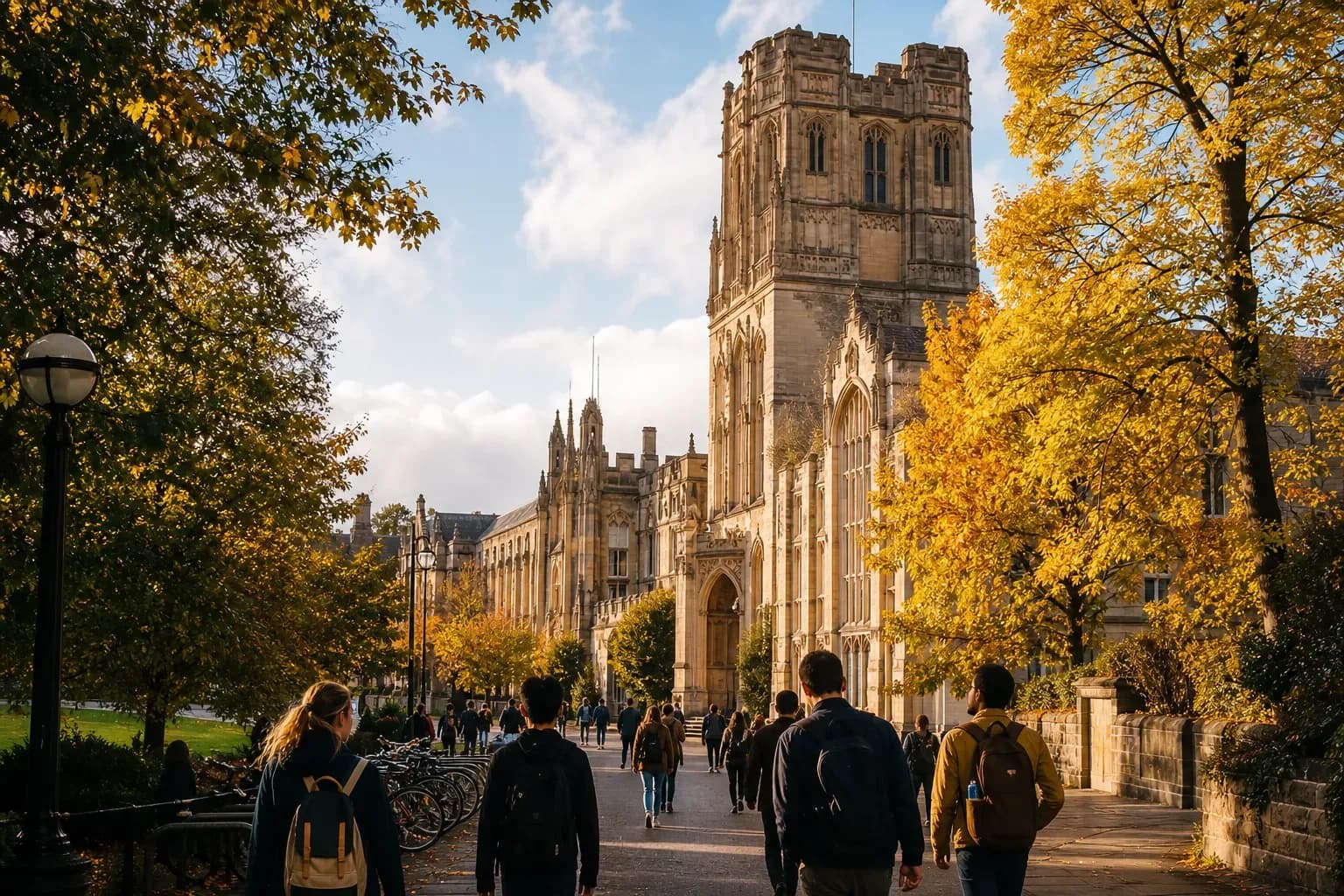
University of Bristol: The UK’s Red Brick Engineering Powerhouse, QS Top 51, Strong in Engineering and Quantum
Published on December 1, 2025
Ranked 51st globally in QS 2026, 80th in THE, and holding dual status as both a Russell Group and Red Brick university, the University of Bristol is “the strongest comprehensive university in South West England.” Bristol was formally established in 1909, with origins tracing back to 1876, and is a core member of the Red Brick Universities. These six universities founded during the Industrial Revolution, Birmingham, Bristol, Leeds, Liverpool, Manchester, and Sheffield, helped define the UK tradition of “research-intensive universities serving regional industry.”
Bristol’s character can be summed up in one line: Red Brick heritage, strengths in engineering and quantum, a student city, and street culture. Bristol is the hometown of the UK graffiti artist Banksy, the headquarters of Aardman Animations (Wallace & Gromit, Shaun the Sheep), and the UK’s fifth-largest technology cluster (Silicon Gorge). A high proportion of Bristol graduates stay in the city for work, and Airbus, Rolls-Royce, BAE Systems, Toshiba Quantum, and HP Labs all have a local presence.
1. Basic Information
| Item | Details |
|---|---|
| Founded | 1909 (Red Brick) / predecessor institution in 1876 |
| Location | Bristol, South West England |
| Campus | Compact campus in the Clifton area |
| Undergraduates | ~23,000 |
| Postgraduates | ~9,000 |
| Membership | Russell Group + Red Brick |
| Motto | Vim promovet insitam (Learning promotes one’s innate power) |
2. World Rankings
| Ranking | Position |
|---|---|
| QS World 2026 | #51 |
| THE World 2026 | #80 |
| Complete University Guide 2026 (UK) | #15 |
| Guardian University Guide 2026 (UK) | #14 |
| QS Engineering | Top 40 |
| QS Veterinary Science | Top 10 |
| QS Aerospace Engineering | Top 25 |
| THE Subject Rankings - Physical Sciences | Top 50 |
3. Admissions Data (2025 entry)
| Indicator | Figure |
|---|---|
| Applicants | ~58,000 |
| Admitted students | ~7,300 |
| Overall acceptance rate | Approx. 13% |
| International applicant acceptance rate | ~11% |
| Medicine acceptance rate | ~9% (UCAT + interview) |
| Vet acceptance rate | ~12% |
| Yield Rate | ~48% |
| International student proportion | ~30% |
Typical A-Level / IB Offers
| Subject Area | Standard A-Level Offer | Standard IB Offer |
|---|---|---|
| Medicine (MBChB) | AAA (Chemistry + Biology) + UCAT | 36 points (HL 666) |
| Vet Science (BVSc) | AAA (Biology + 1 science subject) + work experience | 36 points (HL 666) |
| Engineering | A*AA (including Math + Physics) | 37 points (HL 666) |
| Math | A*A*A (Math + Further Math) | 38 points (HL 776 including HL Math) |
| Economics | A*AA (including Math) | 37 points (HL 666 including HL Math) |
| Law (LLB) | AAA | 36 points (HL 666) |
International Students
- International students make up around 30% of the undergraduate population
- Students come from 150+ countries
- Around 10-25 students from Taiwan are admitted each year, mainly in Engineering, Math, and Medicine
- Applications are submitted through UCAS
4. Tuition and Living Costs
2025-2026 International Tuition Fees
| Subject Area | Tuition Fee (per year) |
|---|---|
| Humanities / Social Sciences | £26,200 |
| Economics / Management | £29,300 |
| Engineering / CS / Math / Science | £31,400 |
| Medicine | £37,900 (first 3 years) / £45,800 (clinical years) |
| Vet | £36,500 |
Living Costs (Moderate)
| Item | Amount |
|---|---|
| On-campus or nearby accommodation | £8,000-12,000/year |
| Food + transport + personal expenses | £6,500-8,500/year |
| Total (including tuition) | Approx. £41,000-58,000/year |
Graduate Route Visa
After graduation, students can apply for the Graduate Route, which grants 2 years of UK work permission for master’s / bachelor’s graduates and 3 years for PhD graduates. Bristol graduates often stay in Bristol / Cardiff, with many entering Airbus, Rolls-Royce, and Aardman.
Scholarships
- Think Big Scholarship: £6,500-26,000/year (top-tier international student scholarship)
- Global Scholarships: £10,000-25,000/year
- Chevening / Commonwealth
5. Academic Structure / Flagship Programs
Undergraduate Structure (6 Faculties)
- Faculty of Engineering: Aerospace, Mechanical, Civil, Electrical, Computer Science
- Faculty of Health Sciences: Medicine, Dentistry, Veterinary
- Faculty of Science: Math, Physics, Chemistry, Biology, Earth Sciences
- Faculty of Arts
- Faculty of Social Sciences and Law
- University of Bristol Business School
Flagship Programs
- MEng Aerospace Engineering: A UK Top 5 aerospace engineering program, alongside Imperial / Cambridge. Many graduates enter Airbus (the Filton site is in Bristol) and Rolls-Royce
- MEng Mechanical Engineering: UK Top 5
- BSc / MSci Physics (including Quantum Physics): Bristol Quantum Engineering Centre is a major UK hub for quantum technology
- MBChB Medicine: UK Top 15 medical school
- BVSc Veterinary: UK Top 5 veterinary program
- MA / BA English: UK Top 5 English department
- BSc Economics: High-density quantitative training at undergraduate level
- BSc Computer Science: UK Top 15
Teaching Style
Bristol uses a three-layer teaching structure of lectures (80-200 students) + tutorials (10-15 students) + labs / seminars. Engineering departments include extensive group projects and industry placements.
6. Campus Culture / University Personality
Bristol’s personality is liberal, artistic, practical in engineering, and strongly student-oriented. Bristol is one of the UK cities most popular with students. Banksy street art, Aardman Animations, and the annual Bristol International Balloon Fiesta are central to the city’s culture.
Bristol SU
There are 200+ societies, with the best-known including Bristol Engineering Society, Bristol Investment Society, and Bristol Aerospace Society.
Sports Culture
Bristol Sport includes rugby, rowing, and football, and Bristol has long ranked in the BUCS Top 15.
University Personality
Two well-known jokes about Bristol students are: "Bristol is the cooler version of Oxford" and "Clifton vs Stokes Croft". Clifton is the affluent area, while Stokes Croft is the artsy graffiti district, and student life tends to split between these two poles.
7. Location / Campus Environment
City Positioning
Bristol is the largest city in South West England, with a population of 480,000. It is 1.5 hours by train from London Paddington, 15 minutes from Bath, and 50 minutes from Cardiff. Bristol Airport offers international routes.
Campus Structure
- Clifton main campus: All faculties are concentrated in the Clifton area, with campus buildings spread across University Road, Tyndall Avenue, and Park Row
- Langford Veterinary School (20 km outside the city)
Climate
- South West England, with winters around 2-8°C and summers around 14-22°C
- Relatively mild, with moderate rainfall
Campus Landmarks
- Wills Memorial Building (Gothic tower, 1925)
- Royal Fort House (Georgian building and campus heritage site)
- The Victoria Rooms (student union and music center)
- Clifton Suspension Bridge (designed by Brunel, a landmark outside campus)
- Bristol Aerospace Centre (aerospace exhibition venue)
8. Research and Resources
Libraries
- Arts and Social Sciences Library
- Wills Memorial Library (inside the Wills Building)
- Medical Library (Bristol Royal Infirmary)
Notable Research Centers
- Bristol Quantum Engineering Technology Centre (QET Labs): One of the UK’s national centers for quantum technology
- Bristol Composites Institute: Composites + aerospace
- Cabot Institute for the Environment: Environmental science
- Bristol Synthetic Biology Centre (BrisSynBio)
9. Notable Alumni
- Nobel Prizes: 13 Nobel Laureates, including Paul Dirac (a founder of quantum mechanics) and Cecil Powell (discovery of the meson)
- Politics: Justin Welby (former Archbishop of Canterbury), and multiple UK MPs
- Science: Paul Dirac (Nobel Prize in quantum mechanics, 1933), Cecil Powell (Nobel Prize in particle physics, 1950)
- Business: Bishop John Sentamu, and several Aardman founders
- Performing Arts: Simon Pegg, David Walliams, Matt Lucas, Eddie Redmayne (attended briefly)
- Academia: Sir Michael Berry (theoretical physicist after whom the Berry phase is named)
10. Bristol Facts
- Paul Dirac was a Bristol alumnus: Co-recipient of the 1933 Nobel Prize in Physics, a founder of quantum mechanics, and a graduate of Bristol’s electrical engineering department before moving into physics.
- Bristol is Banksy’s hometown: The street art master Banksy was born in Bristol, and his original works can be seen across the city.
- Aardman Animations is headquartered in Bristol: Wallace & Gromit, Chicken Run, and Shaun the Sheep were all produced in Bristol.
- A quantum technology hub: Bristol Quantum Engineering Centre is a national-level research institution in quantum computing and quantum communications.
- Wills Memorial Building is a Neo-Gothic masterpiece: Completed in 1925, it looks like a medieval cathedral and is a Bristol landmark.
- Bristol Balloon Fiesta: Europe’s largest hot air balloon festival is held every August, with free entry for students.
- Clifton Suspension Bridge: Designed by Isambard Kingdom Brunel in 1864, it is a source of pride for Bristol’s engineering community.
11. Typical Admitted Student Profile
- A-Level A*AA-AAA or IB 36-37 (HL 666)
- Engineering / Math: Math must be A* or HL 7
- Medicine: UCAT + interview + work experience
- Vet: work experience + interview
- Quantifiable academic passion: subject EPQ, research experience, Olympiad, engineering competitions such as F1 in Schools
- Personal Statement of 4,000 characters / 47 lines: 75% academic + 25% extracurricular
- Bristol tends to favor students who are “broadly academic and genuinely interested in Bristol’s city culture”
12. What Kind of Student Is Bristol Best For?
✓ Best suited for:
- Students who want to study Aerospace, Mechanical, Quantum, or Math
- Students who want to study Medicine, Vet, or pure humanities subjects such as English
- Students who can adapt to a large city that is smaller than London and rich in culture
- Students who want a middle-class city lifestyle and tuition lower than Imperial
- Students who like art, graffiti, and animation culture
- Students who want to stay in the UK and work at Airbus, Rolls-Royce, or Aardman
✗ Not necessarily suited for:
- Students looking for an Oxbridge-style college system atmosphere (Bristol does not have a college system)
- Students on a very tight budget who need low living costs (Bristol is more expensive than Manchester / Leeds)
- Students who want the convenience of London Zone 1 city life
- Students who want a business school pipeline straight into City investment banking (consider LSE / Warwick)
- Students looking for an ultra-competitive academic atmosphere
Conclusion
Bristol is not a “any Russell Group university will do” option. Bristol has a clear DNA of its own: Red Brick engineering heritage, quantum technology, Banksy’s artistic atmosphere, and Airbus / Rolls-Royce alumni connections. Bristol is for students who already know at 18 that they want to pursue Aerospace / Mechanical / Quantum, hope to stay in the UK engineering sector, and can embrace life in South West England.
If your path is “I want to become an aerospace engineer, work at Airbus Filton, and take part in the UK’s national quantum computing programs,” Bristol is one of the strongest UK options outside Imperial and Oxbridge. If your goal is pure business and management with a direct route into City investment banking, Bristol is not the first choice.
One point Taiwanese families often overlook is this: Bristol’s standing in engineering and quantum physics within the UK is comparable to Imperial’s standing in engineering globally. Bristol Aerospace and Bristol Quantum Engineering carry a level of trust in the UK engineering sector that is on par with Imperial. Paul Dirac’s quantum mechanics began to take shape at Bristol, and that scientific legacy remains part of the core DNA of Bristol’s physics department today. If you can accept that Bristol is not in London and does not offer a classical Oxbridge atmosphere, Bristol is a very high-ROI choice for engineering and science in the UK.
Sources: