
Bond University: Australia’s First Private Not-for-Profit University, Gold Coast Small-Class Flagship, 2-Year-8-Month Accelerated Degree
Published on February 3, 2026
Bond University, ranked around #700 globally in QS 2026, is one of the easiest Australian universities for Taiwanese families to dismiss after seeing the ranking alone. But that number seriously underestimates Bond’s real quality. Bond is Australia’s first private not-for-profit university (founded in 1989 through donations from businessman Alan Bond and Japan’s EIE Group), one of the Australian universities with the lowest student-to-faculty ratios (1:10, and 1:8 in some programs), the only university in Australia using a three-semester system that allows students to complete a Bachelor’s degree within 2 years and 8 months, and home to one of Australia’s leading private law schools, Bond Law School. Its character is completely different from Australia’s other 41 public universities. Its closest comparison is not UWA or Macquarie, but American Liberal Arts Colleges such as Williams College and Pomona.
Before discussing Bond’s value, however, several points need to be made clear. First, QS #700 does not equal poor quality: Bond is extremely small, with about 6,000 students across undergraduate and postgraduate levels, making it one of Australia’s smallest universities. Its research output is naturally limited, and the university does not strategically invest large amounts of data and resources into QS ranking submissions. It chooses to put resources into teaching quality rather than ranking PR, so its ranking numbers have never looked impressive. Second, tuition is very high: annual tuition is around AUD 60,000-80,000+, and even after compressing a 3-year Bachelor’s degree into 2 years and 8 months, total tuition is still around AUD 160,000-220,000 (NTD 3.6-5 million), about 1.5-2 times the cost of comparable Go8 programs. Third, it was not Rupert Murdoch or Westfield, but Alan Bond. This 1980s Australian business tycoon later went bankrupt and served prison time, but because Bond University is a not-for-profit institution, the university itself is separate from Bond’s personal financial disputes and continues to operate independently today. This article explains Bond’s real positioning, why some families still choose it despite the high tuition, how the Gold Coast offers a regional migration advantage, and what Taiwanese families should understand strategically.
1. Basic Information
| Item | Details |
|---|---|
| Founded | 1989 (Australia’s first private not-for-profit university) |
| Location | Robina, Gold Coast, Queensland (the only main university campus on the Gold Coast) |
| Campus | Single campus, about 50 hectares, with an artificial lake and palm-lined landscape |
| Undergraduates | ~4,000 |
| Postgraduates | ~2,000 |
| Total students | About 6,000 (one of Australia’s smallest universities) |
| Student-to-faculty ratio | 1:10 (1:8 in some programs, among the lowest in Australia) |
| Motto | Bond University (no Latin motto, consistent with its American LAC-style character) |
| Type | Not-for-profit private university |
Bond is the only fully not-for-profit private university among Australia’s 43 universities. Torrens University is for-profit, while Notre Dame is Catholic and private but different in scale and structure. Bond was founded in 1989 through donations from Australian businessman Alan Bond and Japan’s EIE Development, with its campus located in the emerging Gold Coast urban center of Robina. Alan Bond later went bankrupt and served prison time, but because Bond University is an independent not-for-profit institution, the university’s assets are separated from Alan Bond’s personal finances, and it has continued to operate under an independent board.
2. World Rankings
| Ranking | Position |
|---|---|
| QS World 2026 | ~#700 |
| THE World 2026 | #301-400 |
| ARWU / Shanghai 2024 | Not listed |
| THE Student Experience Survey | Top 3 in Australia for multiple years |
| Good Universities Guide student experience | #1 in Australia for 17 consecutive years |
| QS Law and Legal Studies | Global Top 200 |
| QS Hospitality and Leisure Management | Global Top 50 |
Bond’s ranking profile is unusually polarized. Research-output-driven rankings such as QS and ARWU place it relatively low, while rankings focused on student experience, teaching quality, and employer perception, such as THE Student Experience and the Good Universities Guide, consistently place it among Australia’s top three. Bond has been ranked #1 in Australia for student experience by the Good Universities Guide for 17 consecutive years, a record no other Australian university can match.
The logic behind this gap is straightforward: QS rankings place 40% weight on research output, 20% on international reputation, and 20% on student-to-faculty ratio. Bond is structurally disadvantaged on research output because it is small and has fewer researchers, but it leads on student-to-faculty ratio. Its overall ranking is dragged down by research output. Taiwanese families evaluating Bond should look at student experience and teaching quality indicators, not the overall QS ranking.
3. Admissions Data (International Students, 2026 Application Year)
| Indicator | Value |
|---|---|
| International student ATAR equivalent | 75-95, depending on program |
| IB Diploma | 28-38 points |
| Approximate Taiwan high school GPA threshold | Top 15-30% of class + average 85+ |
| IELTS requirement | 6.5 (6.0 in each band); Law / Medicine 7.0 |
| TOEFL iBT | 79, including Writing 21 |
| Application fee | AUD 100 |
| International student ratio | About 45% (among the highest in Australia) |
| Bachelor of Laws / JD entry threshold | ATAR 90 / IB 36 + written materials |
| Medical Program entry threshold | ATAR 95 / IB 38 + interview + motivation statement |
| Bachelor of Business / Commerce entry threshold | ATAR 80 / IB 30 |
International Students
- International students make up about 45% of the student body, one of the highest proportions among Australian universities (Melbourne is around 40%, Bond around 45%)
- Students come from 90+ countries, mainly the United States (Bond directly positions itself against American LACs and has strong awareness among American families), China, India, and Canada
- About 30-50 Taiwanese students enroll each year (very few, because tuition is high)
- Important: Bond uses rolling admissions. There are three intakes each year, in January, May, and September, making it more flexible than the February / July two-semester system at other Australian universities
4. Tuition and Financial Aid
2026 International Student Tuition (Annual)
| Program category | Annual tuition in AUD | Approx. NTD conversion (AUD 1 = NTD 22.6) |
|---|---|---|
| Bachelor of Arts | About AUD 56,000 | About NTD 1.27 million |
| Bachelor of Business | About AUD 62,000 | About NTD 1.40 million |
| Bachelor of Laws (LLB) | About AUD 65,000 | About NTD 1.47 million |
| Bachelor of Commerce | About AUD 62,000 | About NTD 1.40 million |
| Bachelor of Film and Television | About AUD 60,000 | About NTD 1.36 million |
| Bachelor of Hotel and Tourism Management | About AUD 58,000 | About NTD 1.31 million |
| Bachelor of Medical Studies / MD (5-year program) | About AUD 80,000+ | About NTD 1.81 million+ |
| Juris Doctor (JD) | About AUD 70,000 | About NTD 1.58 million |
| Living expenses (Gold Coast Robina) | About AUD 26,000-34,000 | About NTD 590,000-770,000 |
The key point is the total cost under the three-semester system. Bond has three semesters per year (January, May, September), and students can study continuously. A 3-year Bachelor’s degree can be completed within 2 years and 8 months, with total tuition of about AUD 160,000-220,000 (NTD 3.6-5 million). This is 30-50% more expensive than comparable programs at USYD / UNSW, but the timeline is 4 months shorter than Go8, allowing students to enter the job market / migration clock earlier.
Scholarships
- Bond Vice-Chancellor's Elite Scholarship: 25-50% tuition reduction for top students
- Bond International Excellence Scholarship: 25% tuition reduction, usually requiring ATAR 90+ / IB 36+
- Bond Sports Scholarship: athletic scholarship with partial reduction
- Faculty-Specific Scholarships: individual awards in law, business, and communication
- Important: Bond does not offer Need-Based Financial Aid to international students. All reductions are Merit-Based and do not consider family income
The most practical reminder for Taiwanese families: Bond’s tuition threshold is a real filter. It is not like USYD or UNSW, where tuition is expensive but scholarship opportunities are broader. Bond is a “high tuition + Merit-Based discount” university. If your family budget can cover NTD 4-6 million for an undergraduate degree, excluding asset considerations such as family property, Bond is worth evaluating. If your family needs financial aid to attend an international university, Bond is not suitable.
5. Program Structure: Three-Semester System + 2-Year-8-Month Accelerated Bachelor’s Degree
Australia’s Only Three-Semester System
Bond is the only university in Australia using a three-semester system. The year is divided into three 14-week semesters in January (Semester 1), May (Semester 2), and September (Semester 3). Students can study continuously, allowing a 3-year Bachelor’s program to be completed in as little as 2 years and 8 months (8 semesters).
| Program type | Traditional university timeline | Bond accelerated timeline |
|---|---|---|
| Bachelor of Business | 3 years | 2 years and 8 months |
| Bachelor of Laws (LLB) | 4 years | 3 years and 4 months |
| Bachelor of Communication | 3 years | 2 years and 8 months |
| Juris Doctor (JD, postgrad) | 3 years | 2 years |
For students whose goal is to start work or enter graduate school as soon as possible, this 4-month acceleration matters. But it also means there is no summer vacation. Bond students study at a more compact pace than Go8 students, with three continuous semesters and only 2-3 week short breaks between final exams and the next term.
Signature Programs
- Bond Law School (LLB / JD): one of Australia’s leading private law schools, with alumni including High Court judges and partners at top Australian firms
- Medical Program (MD, 5-year program): one of Australia’s private medical schools, including clinical training
- Bond Business School: AACSB / EQUIS accredited, with small-class case teaching
- Bachelor of Hotel and Tourism Management: QS Global Top 50, with the on-campus Bond Hotel serving as a student training site
- Bachelor of Film and Television: one of Australia’s top film programs, with an on-campus Hollywood-style studio
- Bachelor of International Relations: exchange collaboration with Washington, D.C. think tanks
- Bachelor of Sport Management: partnerships with organizations such as the Gold Coast Titans rugby club and the Australian Open
What This Means for Taiwanese Students
- Advantages: 1:10 small classes, professors know students by name, graduation in 2 years and 8 months, Gold Coast regional advantages
- Drawbacks: high tuition, no summer vacation, Gold Coast is not a financial center
- Consultant’s advice: If your budget is flexible, you want an American LAC-style experience, you are interested in Law / Business / Hotel Management, and you want to graduate and move on in 2 years and 8 months, Bond is the only option like this in Australia
6. Campus Culture / Institutional Personality
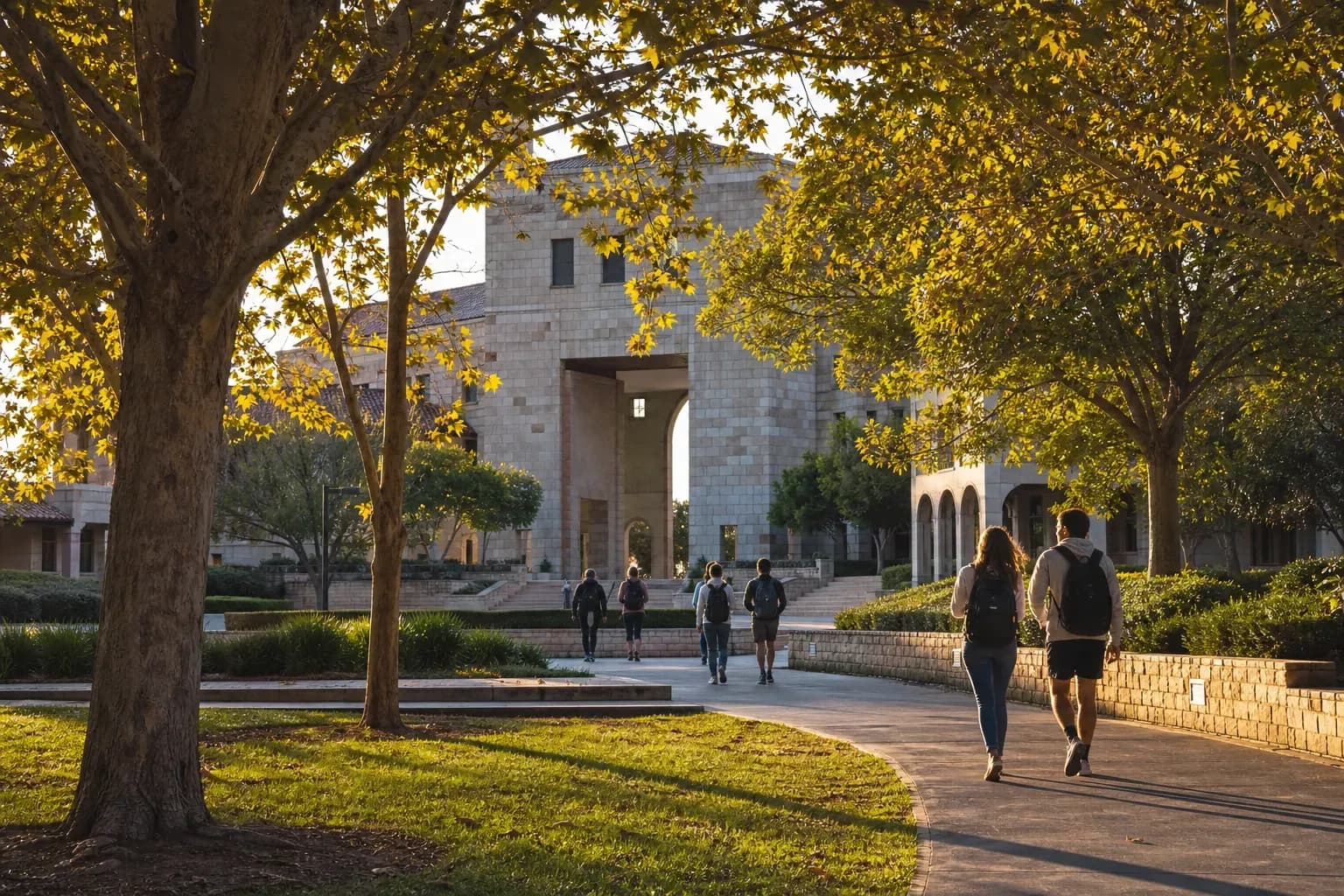
Bond’s personality can be summarized in three words: polished, small-class, coastal resort-like. It does not have USYD’s 1850 sandstone tradition, UNSW’s hard-edged engineering character, or Macquarie’s quiet northern-suburbs greenery. It is a Gold Coast Robina university with an artificial lake, palm trees, Spanish Mediterranean architecture, and a coastal resort-city setting. The first impression on Bond’s campus is that it feels like a smaller version of a private university in California or Florida, such as Pepperdine. The campus has a central artificial lake, white arched buildings, and students in athletic wear studying at lakeside cafes.
The student body leans toward wealthy Australian white families, American international students, affluent Asian families from China, Hong Kong, Taiwan, and Southeast Asia, and Middle Eastern international students. Bond students’ family socioeconomic background is visibly higher than at public universities, a result of the tuition filter and part of why Bond can be compared with American private LACs. The campus atmosphere is polished and quiet, professors know students individually, and peer support among older and younger students is close-knit. If your family in Taiwan comes from an international school background, wants American-style small classes, and dislikes the crowded public-university feel of Sydney / Melbourne, Bond may feel like your natural home.
Student Clubs
- Around 70 clubs under the Bond University Student Association (BUSA)
- Bond Law Students' Association (BLSA): one of Australia’s representative student law associations
- Bond Sport and Recreation: active golf, surfing, rugby, and tennis clubs
Sports Culture
- Bond Sports Centre: Olympic-standard swimming pool, gym, indoor sports facilities
- Signature sports: rugby, golf, surfing, tennis, rowing
- Bond is one of the few Australian universities offering NCAA-style athletic scholarships, another American-style feature that sets it apart from Australian public universities
7. Location / Campus Environment
City Positioning
The main campus is located in Robina, Gold Coast, Queensland, an emerging inland urban center on Queensland’s Gold Coast. It is 15-20 minutes from Surfers Paradise beach by walking + bus, 25 minutes from Gold Coast Airport, and 75 minutes from Brisbane CBD. The Gold Coast is Australia’s sixth-largest city, with a population of about 680,000, and is known for beach resorts, theme parks such as Dreamworld, Sea World, and Movie World, and surfing culture.
The most important strategic point: the Gold Coast is classified as a “City and Major Regional Centre.” For PR points, this means:
| Category | Included areas | 491 / migration points |
|---|---|---|
| Major Cities | Sydney, Melbourne, Brisbane CBD, Perth | No regional benefit |
| City and Major Regional Centres | Gold Coast, Newcastle, Wollongong, Sunshine Coast, Hobart, Geelong, Adelaide, Canberra, Perth | Eligible for 491 regional visa benefits + 485 regional +1 year benefit |
| Regional Australia | Other smaller towns | 491 + regional +2 year benefit |
The Gold Coast is a PR-friendly hidden advantage. It is not a “major city” like Sydney / Melbourne / Brisbane CBD, where there is no regional benefit. It is a “major regional centre” with regional advantages. For families targeting PR, the Bond + Gold Coast regional benefit combination is a seriously underestimated strength. Tuition is high, but the regional benefit is stable, making this strategy very reasonable for families with a flexible budget who are pursuing PR.
Climate
- Summer (December-February): 22-30°C, humid, afternoon thunderstorms
- Winter (June-August): 12-22°C, sunny and dry
- The Gold Coast has one of the most comfortable climates in Australia, with an average of 245 sunny days per year and year-round surfing
Campus Landmarks
- Don Matheson Bond University Library: the center of the white Spanish-style architectural complex
- Bond Hotel: an operating 4-star hotel on campus and a training site for Hotel Management students
- Bond Sports Centre: golf course, rugby fields, indoor sports hall
- The Arch: a campus landmark with Spanish arcade architecture
- Bond Stadium: rugby and athletics stadium
- Bond Law Library: a legal collection center supported by alumni donations
8. Research and Resources
Bond’s research funding is far smaller than Go8 universities, with annual research income of about AUD 15 million, but its research concentration is focused in four areas: law, business, health sciences, and communication.
Key Research Institutes
- Centre for Commercial Law: commercial law research center
- Centre for Data Analytics: business data analytics
- Institute of Sustainable Development and Architecture
- Faculty of Health Sciences and Medicine: collaboration with Gold Coast Hospital medical center
Industry Connection
Bond’s industry collaborations are mainly concentrated in law firms, Big Four accounting, sports, media, and entertainment:
- Australia’s Big Four accounting firms (Deloitte, EY, KPMG, PwC): main graduate trainee pathways for the business school
- King & Wood Mallesons / Allens / Herbert Smith Freehills: law school internship partnerships
- Gold Coast Titans (NRL rugby club): internships for sport management students
- Movie World / Warner Bros. Australia: internships for film students
- Bond Hotel itself: internships for hotel management students
For students whose goal is PR, Bond’s combination of Gold Coast regional benefits, intensive 1:10 professor support, and internship pipelines into major firms is a viable PR pathway for Taiwanese families willing to take the private small-class route.
9. Notable Alumni
- Politics / Law: Frances Adamson, former Secretary of the Australian Department of Foreign Affairs and Trade, partial program; multiple judges in Australian High Courts and Federal Courts
- Business: Mitchell Pearce, Australian rugby player and business student; multiple Big Four accounting partners
- Film / Entertainment: Joel Edgerton, Australian actor and lead actor in Loving and Warrior, partial program; Mia Wasikowska, partial program
- Sports: multiple Australian rugby players and Olympic swimming representatives
- Academia: Bond alumni relatively rarely enter academia, which is typical for private LAC-style institutions
Bond alumni are strongest in law, business, sports, and media / entertainment. However, the alumni base itself is small, with about 1,500 graduates each year, so the alumni network is far less broad than Go8. But its “density” is very high. Bond graduates on LinkedIn are unusually likely to respond to messages from younger students from the same university.
10. Bond Fun Facts
- Australia’s first private not-for-profit university: founded in 1989 through donations from Alan Bond and Japan’s EIE. At the time, it was a bold experiment in Australia’s education regulatory system, and the university remains Australia’s only private not-for-profit comprehensive university.
- #1 in Australia for student experience in the Good Universities Guide for 17 consecutive years: this is a record even Go8 cannot match. Bond puts resources into teaching quality rather than ranking PR, and student feedback has led Australia for 17 consecutive years.
- Three-semester system + graduation in 2 years and 8 months: Australia’s only academic structure of this kind, allowing students to graduate 4 months earlier. For students who want to work or enter graduate school as soon as possible, those 4 months matter.
- An operating 4-star hotel on campus: Bond Hotel is university-owned and serves as a training site for Hotel Management students. This “campus = training site” model is unique to Bond in Australia.
- The controversy around Alan Bond and the university name: Alan Bond went bankrupt and served prison time in the 1990s, but Bond University is an independent not-for-profit institution, and university assets are separated from Alan Bond’s personal finances. The school continues to operate steadily today, making this a distinctive case in Australian business history.
- The Gold Coast is a PR-friendly hidden advantage: classified as a City and Major Regional Centre, it offers access to 491 regional visa benefits and a 485 regional +1 year benefit. This is an invisible advantage for families with flexible budgets pursuing PR.
11. Typical Admitted Student Profile
- Taiwanese international school students with IB predicted scores of 30-38 (36+ for Law / Medicine), or ATAR equivalent 80-95
- Taiwan high school system: top 15-30% of class, average GPA 85+
- IELTS 6.5-7.0 (7.0 for Law / Medicine) or TOEFL iBT 79-90+
- Extracurriculars: the Law track values MUN, debate, and social-issue writing; business tracks look at internships, student council, and marketing; film tracks look at portfolios
- Some Medicine and Law programs require interviews; most other programs do not require interviews
- A Personal Statement is required for many programs, with the key question being “why Bond”
- Family budget assessment: annual costs of AUD 60,000-80,000+ require families to have a clear budget of at least NTD 4-6 million
12. What Kind of Student Is Bond Suitable For?
✓ Suitable for:
- Families with flexible budgets, whose annual income / assets can support NTD 4-6 million+ in education costs
- Students who want an American LAC-style small-class experience with a 1:10 student-to-faculty ratio and dislike the crowded feel of Australian public universities
- Students interested in Law, Business, Hotel Management, Film/TV, or International Relations
- Students who want to graduate as quickly as possible in 2 years and 8 months and enter the job market or graduate school
- Families pursuing PR who want to use the Gold Coast regional advantage together with Bond’s high-quality teaching
- Students from international school systems who are used to English-medium instruction and want an experience that feels aligned with American LACs
✗ Not necessarily suitable for:
- Families with tight budgets who need financial aid (Bond does not provide need-based aid)
- Families focused on “QS ranking numbers” (Bond’s ranking will not look attractive)
- Students who want purely research-oriented programs or aim for a future PhD / academic career (Go8 has deeper research resources)
- Students who want CBD metropolitan life and financial-district internship opportunities (the Gold Coast is not a financial center)
- Students focused on pure STEM, quantum, AI, or Pure Mathematics (Bond is not a STEM powerhouse)
- Students who want a summer break (the three-semester system runs continuously)
Conclusion
Bond is one of the Australian universities that most requires Taiwanese families to “recalibrate how they read” it. QS #700 seriously underestimates its teaching quality, but its real value lies in being Australia’s only private not-for-profit university, having one of the country’s lowest student-to-faculty ratios at 1:10, offering an accelerated 2-year-8-month degree, ranking #1 for student experience in the Good Universities Guide for 17 consecutive years, benefiting from Gold Coast regional advantages, and housing a top law school. Taken together, these features create a private LAC flagship positioning that QS rankings cannot capture.
From a migration strategy perspective, Bond has three advantages: (1) the Gold Coast is a City and Major Regional Centre, giving graduates a 485 regional +1 year benefit and a clear 491 regional visa pathway; (2) graduating in 2 years and 8 months allows students to enter the 485 timeline 4 months earlier than Go8 students; (3) Bond Law / Business / Hotel Management have very strong graduate trainee employer reputations in industry. Law firms, in particular, are unusually receptive to Bond alumni for a small private university. In the master’s database at Dr. G. Academy, combinations such as Bond’s “JD / Master of Business / Master of Hotel Management + Gold Coast regional benefits” are among the most underestimated PR pathways for families with flexible budgets.
Dr. G. always speaks plainly about less popular but strategically smart choices: Bond does not let you buy quality through ranking, high tuition is a real filter, the Gold Coast is not a financial center, and its research resources are not as deep as Go8. But for families with flexible budgets who want an American-style small-class experience, are interested in law or hotel management, and aim to graduate and move on in 2 years and 8 months, Bond is the only option of its kind in Australia. It is not a substitute for Go8. It is Australia’s exclusive provider of an LAC-style university experience.
Bond is a private flagship built for people who understand that brand does not equal ranking.