
Australian National University: Australia's Only National Flagship, Canberra's Policy Core, and a Powerhouse in Astronomy and Space Research
Published on February 23, 2026
Ranked #32 globally in QS 2026, Australian National University, commonly known as ANU, is the most distinctive member of Australia's Group of Eight (Go8). It is the only university in Australia established by an act of the federal parliament. The other seven Go8 universities are state universities: Melbourne belongs to Victoria, while UNSW and Sydney belong to New South Wales. Only ANU is a National University, created directly by the Australian Parliament through the Australian National University Act in 1946, with the mission of "training policy elites for the young Australian federation and advancing postwar nation-building." This identity gives ANU government connections that no other Australian university can match in political science, public policy, international relations, defense strategy, and Southeast Asian studies.
But ANU's identity is not only about its legal status. It is located in Canberra, Australia's capital and the seat of the federal government, but also one of the cities students complain about most. Canberra has a population of only 460,000. It is not the bustling metropolis that Sydney or Melbourne is. Nightlife and restaurant options are limited. It is 150 kilometers from the coast and is sometimes jokingly called "Australia's desert" by students. For Taiwanese students who want a lively urban lifestyle, this is the biggest reason not to choose ANU. But for students who want to become diplomats, conduct policy research, enter the United Nations, or enjoy a quiet academic environment, Canberra's "emptiness" becomes a gift of focus. Your classmates may become future Australian prime ministers, ambassadors to the United States, or officials in the Department of Foreign Affairs and Trade. This peer group is something other Australian universities cannot offer.
1. Basic Information
| Item | Details |
|---|---|
| Founded | 1946 (established by federal parliamentary legislation, the only one in Australia) |
| Location | Acton, Canberra, ACT (central Canberra, 4 km from Parliament House) |
| Campus | Main campus of about 145 hectares, plus Mt Stromlo Observatory in suburban Canberra and Siding Spring Observatory in NSW |
| Undergraduates | ~12,000 |
| Postgraduates | ~12,000 |
| Student-faculty ratio | 1:13 (the best among the Go8) |
| Motto | Naturam Primum Cognoscere Rerum (First, to understand the nature of things) |
ANU is the smallest flagship university in the Go8. It has about 24,000 students in total, only one-third the size of USYD and half the size of UNSW. This "smallness" is actually one of its strengths: its 1:13 student-faculty ratio is the best in the Go8, significantly more intensive than USYD and UNSW at around 1:18. For Taiwanese students, this means more one-on-one access to professors, smaller seminars, and more direct research supervision.
2. World Rankings
| Ranking | Position |
|---|---|
| QS World 2026 | #32 (fourth in Australia) |
| THE World 2026 | #73 |
| ARWU / Shanghai 2024 | #76 |
| QS Politics & International Studies | #6 (sixth globally) |
| QS Geography | #11 |
| QS Anthropology | #11 |
| QS Philosophy | #17 |
| QS Earth & Marine Sciences | #20 |
| QS Development Studies | #15 |
| US News Global Universities | #50 |
ANU trails Melbourne, UNSW, and Sydney in the overall QS ranking, but it completely dominates the rest of the Go8 in "soft disciplines" such as politics, geography, anthropology, philosophy, and development studies. For Taiwanese students, this means: if you want to study Political Science, International Relations, Public Policy, Asian Studies, Anthropology, or astrophysics, ANU is unmatched within the Go8; if you want pure business or pure engineering, ANU is not the first choice.
3. Admissions Data (International Students, 2026 Application Year)
| Indicator | Value |
|---|---|
| International student ATAR equivalent | 78-98 (depending on program) |
| IB Diploma | 30-43 points |
| Approximate threshold for Taiwanese high school GPA | Top 15% of class + near-perfect grades |
| IELTS requirement | 6.5 (6.0 in each band); Law and PPE 7.0+ |
| TOEFL iBT | 80 (including Writing 20) |
| Application fee | AUD 100 (international undergraduate applicants; some programs are free) |
| International student ratio | About 30% |
| Bachelor of Philosophy (Honours) entry threshold | ATAR 95+ / IB 40+ + interview + written materials |
| Politics, Philosophy, and Economics (PPE) threshold | ATAR 95+ / IB 40+ |
| Bachelor of Astronomy & Astrophysics threshold | ATAR 85+ / IB 35+ |
International Students
- International students make up about 30% of the student body, relatively low among the Go8 and below Melbourne and Sydney at 40-42%
- Students come from 100+ countries, with stronger concentrations from Southeast Asia, China, India, and the South Pacific
- About 50-100 Taiwanese students enroll each year across undergraduate and graduate levels, far fewer than at UNSW or USYD
- Popular bottlenecks: Bachelor of Philosophy (Honours), PPE, Asia-Pacific Studies, and Master of International Affairs are the most competitive
Why Are There So Few Taiwanese Students?
To be blunt: Canberra has a high deterrence rate. Many Taiwanese parents hesitate as soon as they hear "not Sydney, not Melbourne." But this also makes ANU a relatively more accessible Go8 entry point for students who truly want to focus on academics and do not want to be distracted by Sydney's urban energy. You do not need an ATAR 99 or IB 43. The threshold is usually 2-3 points lower than equivalent programs at USYD or UNSW.
4. Tuition and Financial Aid
2026 International Student Tuition (Annual)
| Program Category | Annual Tuition in AUD | NTD Estimate (AUD 1 = NTD 22.6) |
|---|---|---|
| Bachelor of Arts | About AUD 48,000 | About NTD 1.08 million |
| Bachelor of Commerce | About AUD 53,000 | About NTD 1.20 million |
| Bachelor of Science | About AUD 53,000 | About NTD 1.20 million |
| Bachelor of Engineering (Honours) | About AUD 54,000 | About NTD 1.22 million |
| Bachelor of Philosophy (Honours) | About AUD 50,000 | About NTD 1.13 million |
| Master of International Affairs | About AUD 51,000 | About NTD 1.15 million |
| Master of Public Policy | About AUD 51,000 | About NTD 1.15 million |
| Living costs (Canberra) | About AUD 28,000-35,000 | About NTD 630,000-790,000 |
ANU's tuition is slightly lower than UNSW and USYD, usually by about AUD 3,000-5,000 per year. Canberra's living costs are also 20-25% lower than Sydney's, although rent has gradually been catching up in recent years. A typical four-year Bachelor's degree costs around NTD 7-8 million in total, much less than the roughly NTD 10 million required at USYD.
Scholarships
- ANU Chancellor's International Scholarship: 25-50% undergraduate tuition reduction, based on ATAR / IB
- ANU Tuition Scholarship: 25% tuition reduction for master's students
- ANU PhD Scholarship: Full doctoral tuition waiver + AUD 36,000 stipend
- Crawford School Scholarships: Scholarships specifically for public policy and development studies
- Need-Based Aid for international students is almost nonexistent
The most practical reminder for Taiwanese families: ANU is the lowest total-cost flagship university in the Go8. If your child wants to study Politics, IR, Asian Studies, or Public Policy, ANU is not only the option with the highest academic ceiling, but also the cheapest. This is a highly underrated value combination.
5. Academic Structure: Boutique Bachelor + Honours
Standard Degree System
ANU follows the traditional Australian 2-Semester + Bachelor system:
- Semester 1: Late February to late June (13 teaching weeks + 3 exam weeks)
- Semester 2: Late July to late November (13 teaching weeks + 3 exam weeks)
- Optional Summer Intensive courses are available during the summer break
Bachelor Structure
- 3-year Bachelor for most programs
- 4-year Bachelor with Honours for Engineering and Bachelor of Philosophy
- Flexible Double Degree: ANU is Australia's most supportive university for double degrees, with almost any combination of Arts + Science + Commerce + Law possible
- Postgraduate Coursework / Research: Extensive Master's and PhD offerings, especially in Asia-Pacific fields
What This Means for Taiwanese Students
- Advantages: Highly flexible, double-degree friendly, research-intensive, with many government internship opportunities
- Disadvantages: The total timeline is not faster than UNSW, and ANU is not suitable for students who are purely job-market oriented
- Consultant's recommendation: If your goal is graduate school plus an academic or policy career, ANU's 4-year Bachelor of Philosophy is the strongest option in the Go8; if you simply want to graduate in three years and enter the workforce quickly, ANU is not the best fit
Signature Programs
- Bachelor of Philosophy (Honours): ANU's flagship elite program, elite even among elite programs, with an ATAR 99-level entry threshold and required research training
- Politics, Philosophy, and Economics (PPE): Modeled after Oxford PPE and designed to train policy elites
- Crawford School of Public Policy: Australia's top public policy school, with direct pathways into the federal government, World Bank, and United Nations
- ANU College of Asia and the Pacific: A world-leading school for Southeast Asian, East Asian, and Pacific studies
- Research School of Astronomy and Astrophysics (RSAA): Australia's top astrophysics research institution, operating Mt Stromlo and Siding Spring Observatory
- ANU College of Law: Australia's strongest school for public law, constitutional law, and international law
- Bachelor of Engineering (Renewable Energy): Solar energy and quantum energy engineering
6. Campus Culture / Institutional Personality
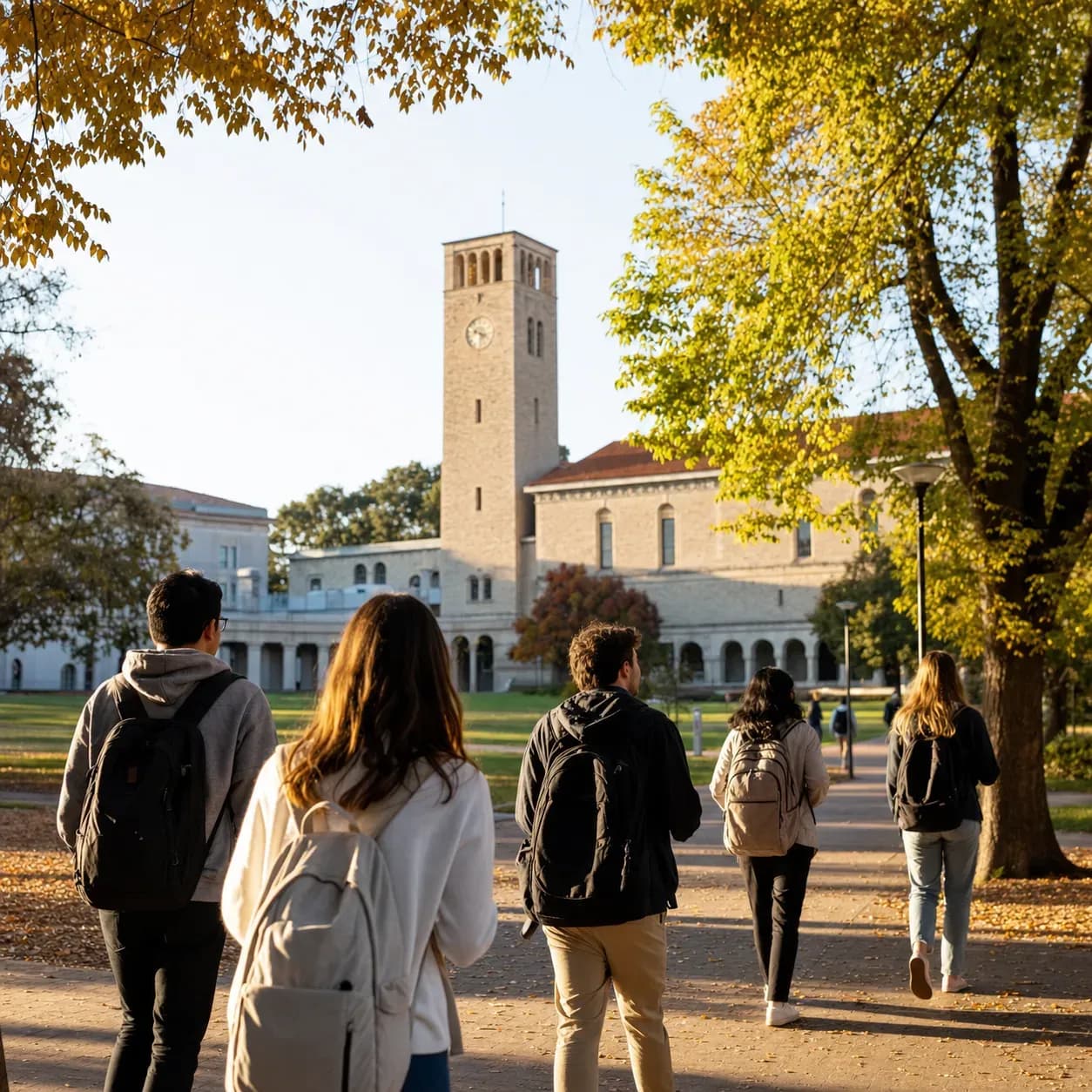
ANU's personality can be summarized in three words: academic, policy-driven, quiet. If UNSW students are writing Python in Mathews Library and USYD students are writing law essays over coffee in Newtown, ANU students are writing foreign policy white papers in Chifley Library, seated next to part-time PhD students who actually work at the Department of Foreign Affairs and Trade.
ANU offers the most graduate-school-like undergraduate experience in the Go8 because it was originally designed for research and policy. Undergraduates make up only half of the student body, and the postgraduate atmosphere permeates the entire campus. Students are more likely to wear business casual than shorts. Conversation topics are more likely to be "China-US relations" than "next week's party." A Friday night event is more likely to be an ANU Press book launch than a Roundhouse party.
Comparison with Other Go8 Universities
- USYD vs ANU: USYD is "old-money children of lawyers"; ANU is "the cradle of civil servants and diplomats"
- Melbourne vs ANU: Melbourne is "metropolitan artsy youth"; ANU is "a policy technocrat research lab"
- UNSW vs ANU: UNSW is "engineer-entrepreneur"; ANU is "think tank researcher"
The most direct difference for Taiwanese students: if your life goal is to enter the United Nations, join the Ministry of Foreign Affairs, become a think tank researcher, enter an Australian government department, or pursue Oxford PPE or SAIS, ANU is the only Go8 university that truly connects to this path.
Student Organizations
- ANU Students' Association (ANUSA): Student union
- ANU Press: Australia's earliest university press, with student editorial participation opportunities
- ANU Politics Society: Works closely with the federal government and parliamentary offices
- ANU Asia-Pacific Week: Annual international student policy forum
- ANU Observers: Student journalism organization, often based in the federal parliamentary press gallery
Sports Culture
- Sport is not ANU's main focus. The campus sits at the foot of Black Mountain
- ANU Mountaineering Club and ANU Bushwalking: Outdoor sports are a strength
- Inter-Varsity Sports: Not in the same league as USYD or UNSW, but ANU still participates in UniSport competitions
7. Location / Campus Environment
City Positioning
The main Acton campus is located in central Canberra on the northern shore of Lake Burley Griffin, 4 kilometers from Parliament House, 10 minutes by car, 3 kilometers from ASIO headquarters, and a 15-minute walk from the embassy district. This location is priceless for students studying international relations and political science. Your class assignment might be to interview a current diplomat. Your classmate may be interning in a senator's office.
Canberra is Australia's capital, with a population of 460,000. It was planned by Walter Burley Griffin in 1913 and is Australia's only planned city. Its economy centers on the federal government, defense, diplomacy, think tanks, and ANU's academic ecosystem. It is not a commercial or financial center.
Climate
- Summer (December-February): 12-28°C, dry inland climate
- Winter (June-August): -3 to 12°C; Canberra is Australia's only capital city that gets frost, with occasional snow
- Significantly colder than Sydney and Melbourne, suitable for students who do not like tropical heat
Why Students Say "Canberra Is a Desert"
To be blunt: Canberra's nightlife, restaurants, shopping, and cultural activities are far behind Sydney and Melbourne. Civic, the city center, can be covered on foot in 30 minutes. Late-night restaurant options are limited. There is no Newtown, no Fitzroy, no Bondi. The most common weekend activities are "driving to Sydney" (3 hours) or "going skiing in the Snowy Mountains" (2 hours).
But this "desert feeling" can be a gift for some students: there are fewer entertainment distractions, there is always a seat in the library, students have more time for deep discussions, and the density of academic output and research training far exceeds USYD and UNSW.
Campus Landmarks
- University Avenue: The main campus axis, planned in the 1950s, connecting ANU with Civic
- Chifley Library / Hancock Library: Main libraries, with 2.5 million volumes
- University House: Built in 1954, Australia's earliest graduate residence and academic club
- Mt Stromlo Observatory: 14 km from campus, Australia's leading observatory
- Lake Burley Griffin: Beside campus, a top choice for student running and rowing
- Black Mountain Tower: Landmark north of campus, a tourist observation tower
- National Library of Australia / National Gallery / War Memorial: National cultural institutions within a 20-minute walk
8. Research and Resources
ANU is Australia's university with the highest research intensity, ranking first in the Go8 for research output per faculty member. Its annual research funding exceeds AUD 900 million.
Key Research Institutions
- Crawford School of Public Policy: Australia's top public policy school, working directly with the federal Treasury and Department of Foreign Affairs and Trade
- Coral Bell School of Asia Pacific Affairs: Strategic studies of Southeast Asia, East Asia, and Pacific countries
- National Security College: A national security school jointly run with the Australian government
- Research School of Astronomy and Astrophysics (RSAA): Operates Mt Stromlo Observatory and Siding Spring Observatory, home to Australia's largest optical telescope
- Research School of Physics: Top-tier physics research in Australia, including nuclear physics and quantum physics
- John Curtin School of Medical Research: A cradle of Nobel Prize-winning medical research
- Centre for European Studies and ANU India Institute: Regional studies networks
The Legend of Space Research
ANU is number one in Australia and among the best in the Southern Hemisphere in astrophysics and space research. Mt Stromlo Observatory was destroyed in the 2003 Canberra bushfires, but ANU rebuilt it on the original site and expanded it into Australia's center for space instrumentation. It is now involved in multiple projects with NASA and the European Space Agency (ESA). Professor Brian Schmidt, winner of the 2011 Nobel Prize in Physics for discovering the accelerating expansion of the universe, teaches at ANU and served as ANU Vice-Chancellor from 2016 to 2025.
9. Notable Alumni
- Nobel Prizes: Brian Schmidt (Physics 2011, Vice-Chancellor 2016-2025), John Eccles (Medicine 1963), Howard Florey (Medicine 1945, penicillin), Peter Doherty (Medicine 1996)
- Prime ministers / politics: Bob Hawke (23rd Prime Minister of Australia, research fellow at ANU), Kevin Rudd (26th Prime Minister of Australia, BA in Asian Studies), Penny Wong (Australian Minister for Foreign Affairs)
- Diplomacy / international affairs: Multiple Australian ambassadors to the United States, China, and Japan
- Academia / think tanks: Hugh White (strategic scholar), John Quiggin (economist), Ramesh Thakur (former UN Assistant Secretary-General)
- Senior government: Many senior officials in the Australian Treasury, Department of Foreign Affairs and Trade, Department of Defence, and ASIO come from ANU
- Science / space: Penny Sackett (former Chief Scientist for Australia)
ANU has the highest per capita concentration of Nobel Prize-associated scholars in the Go8. With only 24,000 students, it has produced four Nobel Prize-related scholars, a density far above Melbourne or USYD.
10. ANU Facts You May Not Know
- Australia's only national university: The only university in Australia established by federal parliamentary legislation, through the Australian National University Act 1946. The other Go8 universities are state universities.
- Mt Stromlo Observatory burned down in 2003: The Canberra bushfires destroyed the entire observatory, including the 74-inch telescope. ANU rebuilt it on the original site, and it is now an Australian space research center.
- A 2011 Nobel Prize winner served as Vice-Chancellor: Brian Schmidt won the 2011 Nobel Prize in Physics for discovering the accelerating expansion of the universe and served as ANU Vice-Chancellor from 2016 to 2025. ANU is the only Go8 university to have had a Nobel laureate as Vice-Chancellor.
- Bachelor of Philosophy (Honours) is Australia's most elite undergraduate program: It has an ATAR 99-level threshold, includes required research training, admits only about 60-80 students per year, and is sometimes called "Australia's Rhodes Scholarship preparatory class."
- Canberra is Australia's only capital city where it can snow: At an elevation of 600 meters and only two hours from the Snowy Mountains, Canberra occasionally sees snow in winter.
11. Typical Admitted Student Profile
- Taiwanese international school students with predicted IB scores of 33-43, or ATAR equivalent 85-98
- Taiwanese high school system: Top 5-15% of class at schools such as Taipei Municipal Jianguo High School, Taipei First Girls High School, Zhongshan Girls High School, The Affiliated Senior High School of National Taiwan Normal University, Wego, KAS, or TAS, with a near-perfect GPA
- IELTS 7.0 or TOEFL iBT 100+; although the official threshold is 6.5/80, Politics, Law, and PPE programs effectively expect 7.0+
- Extracurriculars: ANU values academic curiosity, research interests, and policy thinking. MUN, debate, and research project experience are major advantages; sports and arts are relatively secondary
- Bachelor of Philosophy (Honours) requires an interview + Personal Statement and is highly competitive
- Most general programs do not require interviews. Applications are mainly grade-based, but ANU places more weight on written materials than USYD or UNSW
12. What Kind of Student Is ANU Suitable For?
✓ Suitable for:
- Students who want to study Politics, International Relations, Public Policy, Asian Studies, Anthropology, Philosophy, or Economics
- Students interested in diplomacy, international organizations, the United Nations, or Australian government public service
- Students who like astronomy, physics, and pure science research
- Students who can enjoy a quiet, focused, remote atmosphere and do not need a lively metropolis
- Families with limited budgets who want a Go8 degree at a lower total cost, with undergraduate completion possible at around NTD 7-8 million
- Students planning to apply to graduate school in the United States, such as Harvard Kennedy, Princeton SPIA, SAIS, or Oxford PPE
✗ Not necessarily suitable for:
- Students who want pure business, Finance, Accounting, or Marketing (UNSW, USYD, and Monash are stronger)
- Students who want pure engineering or CS (UNSW and Monash are stronger)
- Students who love beaches, nightlife, and big-city energy (Canberra really may feel suffocating)
- Immigration-oriented students who want a fast PR route through engineering or IT (Canberra's employer market is small, and the PR path is not smooth)
- Students who want large-campus life or Greek Life party culture (ANU has a graduate-school temperament)
Conclusion
Australian National University is the most distinctive, most underrated, and least understood flagship university among general parents in the Go8. Its QS #32 ranking makes many Taiwanese parents instinctively feel that it is "worse than USYD," but that comparison is wrong. In politics, international relations, public policy, anthropology, geography, philosophy, and astrophysics, ANU is number one in Australia and among the best in the world. If your child wants to study these fields, ANU is the only real choice in the Go8. The other universities are substitutes.
From an immigration strategy perspective, ANU has one inconvenient fact: Canberra is not a PR-friendly city. Canberra has a small employer market, limited private-sector employment, and most federal government roles require Australian citizenship, meaning international graduates cannot enter them directly. After a Master Coursework degree, the 485 PHEW Stream is 2 years (the same as other Go8 universities, reduced from 3 years after July 1, 2024). Master Research / PhD graduates receive 3 years. Canberra is not a regional campus and does not receive the additional +1 year on the 485 visa. For students who are purely PR-oriented, ANU is not the most direct pathway. UNSW or Monash with a Sydney / Melbourne engineering + IT combination is more stable.
But for students whose clear goal is policy, diplomacy, academia, or research, ANU gives you something other universities cannot: proximity to the federal government, policy training through Crawford School, the research intensity of Bachelor of Philosophy, and 1:13 student-faculty access to professors. Dr. G. Academy's master's database includes several ANU programs, including Master of Public Policy, Master of International Affairs, and Master of Asian and Pacific Studies. These programs are among the best stepping stones for Taiwanese students applying later to Harvard Kennedy or Princeton SPIA, and often a more stable route than studying political science at National Taiwan University and then applying directly to U.S. graduate school.
The most practical reminder for Taiwanese families: ANU is not a "USYD alternative." It is an "Oxford, LSE, Georgetown SFS alternative." If you compare ANU with USYD, you may think it is weaker. If you place it within the context of policy elite training systems, it is the only Australian option that can stand on the world stage.
ANU is lonely, but that loneliness is ANU's gift. In Canberra's quiet winter, under the reading lamps of Chifley Library at 1 a.m., or while looking up at the Southern Hemisphere sky from Mt Stromlo Observatory, you will understand that this university was not built for noise. It was built for thought. If that is what you want, ANU is an irreplaceable choice within the Go8.