
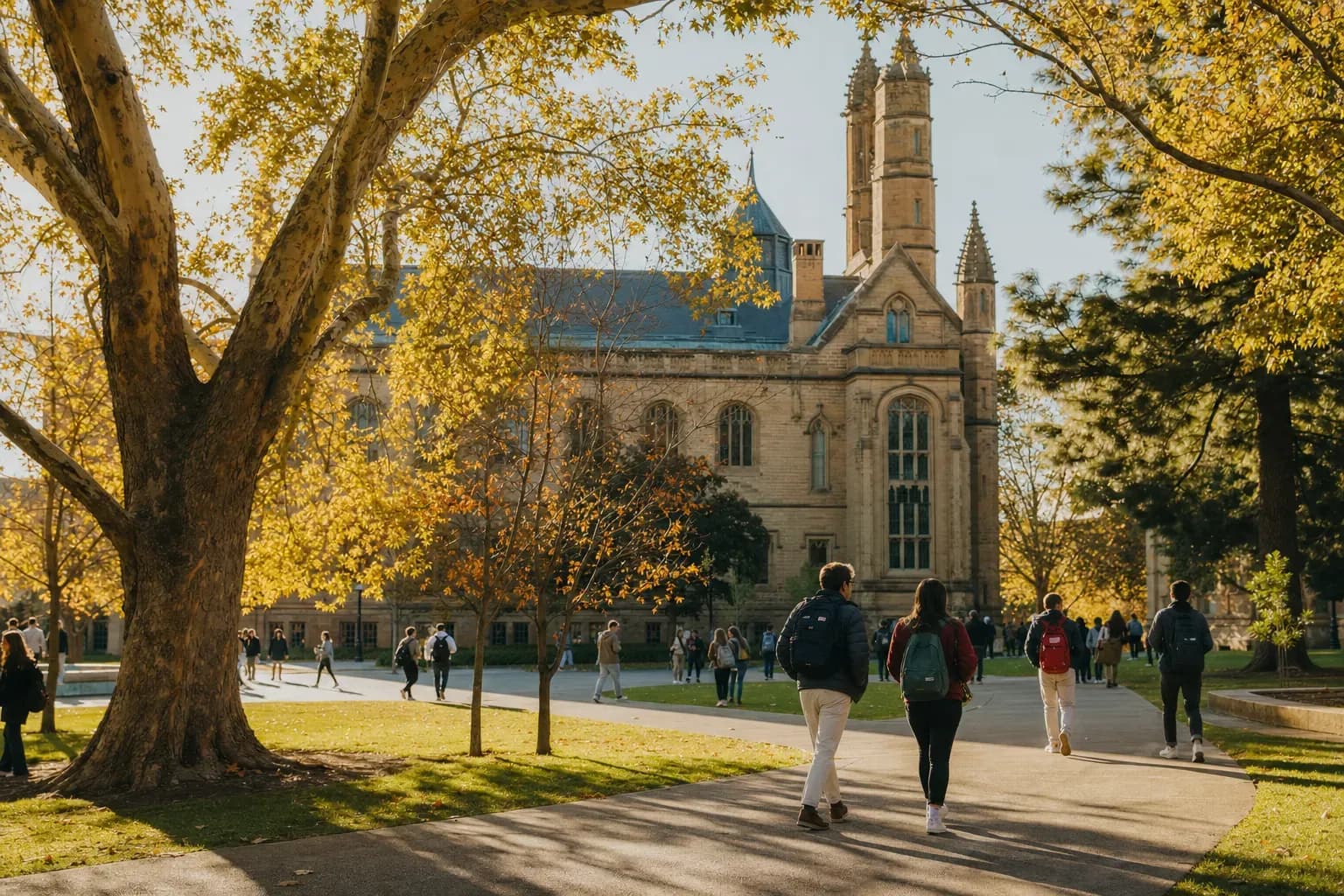
Adelaide University: A New 2026 Merger, Go8 Status, World #1 in Wine Business, and South Australia Transition Risks
Published on February 19, 2026
On January 1, 2026, the higher-education landscape in South Australia was completely rewritten: the former University of Adelaide (a founding Go8 member established in 1874) and the University of South Australia (UniSA, formed in 1991 through the merger of four technical institutes) officially combined into a brand-new Adelaide University. This is the largest single merger in Australian higher-education history. The new university has around 70,000 students, research funding that places it among Australia’s top five, and a QS 2026 ranking inherited from the former UoA at tied #82 (THE 2026, using a different merger assessment logic, dropped it to #176). For Taiwanese families only beginning to explore Australian study options in 2026, this is a university that has “just been born, but is already Go8”: it inherits UoA’s academic lineage and its world-leading Wine Business reputation, while also absorbing UniSA’s strengths in Aboriginal Studies, Design, Nursing, and Education.
But as consultants, we have to be honest: this university is currently in a turbulent integration period. Tuition, program structures, research institutes, admissions offices, student systems, and the entire administrative infrastructure may take 18-24 months to stabilize. Students entering in 2026 and 2027 are, in practice, the “test cohort” of this merger experiment. You may be told during enrolment that “this course uses the old UoA credit system,” or you may suddenly receive a notice in your second semester saying that “this course has been integrated and will now be offered on a former UniSA campus.” If you are a stability-oriented student who dislikes change, Dr. G. would frankly advise you to delay entry by one year and wait for the integration to settle. But if you can read opportunity, this moment may instead be a window for Taiwanese families to capture a three-way combination: “Go8 brand + lower cost + migration-friendly South Australia.” This article will lay out the good, the bad, and the grey areas clearly.
1. Basic Information
| Item | Details |
|---|---|
| Founded | January 1, 2026 (new merged university); former UoA 1874, former UniSA 1991 |
| Location | Adelaide, South Australia (multiple campuses: North Terrace, City East, City West, Mawson Lakes, Roseworthy, Waite) |
| Campuses | 6 major campuses after integration, spanning central Adelaide and suburban areas |
| Undergraduates | ~50,000 (merged estimate) |
| Postgraduates | ~20,000 |
| Total students | Around 70,000 (after merger, one of the largest single universities in the Southern Hemisphere) |
| Student-faculty ratio | 1:22 (in transition, data fluctuating) |
| Motto | Sub Cruce Lumen (The light under the Southern Cross, inherited from the former UoA) |
| Go8 status | Retained (inherited from the former University of Adelaide’s Go8 membership) |
The new university retains UoA’s Latin motto, “Sub Cruce Lumen,” symbolizing “the light of scholarship under the Southern Cross.” This is also a key symbol of its Go8 lineage. In other words, the new Adelaide University is, institutionally, UoA absorbing UniSA, but in actual resources, student scale, and regional influence, UniSA’s assets have all come into the new institution.
2. World Rankings
| Ranking | Position |
|---|---|
| QS World 2026 | #82 (tied, inherited from former UoA) |
| THE World 2026 | #176 (significant downward revision in the first merger year) |
| ARWU / Shanghai 2024 | Former UoA #101-150 band |
| QS Hospitality, Leisure & Wine Studies | #1 globally (former UoA Waite Campus Wine Business) |
| QS Petroleum Engineering | Top 30 globally |
| QS Dentistry | Top 50 globally |
| QS Veterinary Science | Top 50 globally |
| QS Agriculture & Forestry | Top 50 globally |
| QS Nursing (former UniSA strength now integrated) | Top 100 globally |
Key reminder: QS 2026 was released in June 2025, when Adelaide University had not yet officially merged (the merger only took effect on 2026-01-01). QS handled this by using the former University of Adelaide’s data and ranking (#82), marked as tied with a note that it is a newly merged institution. THE 2026 took a more conservative approach: it reassessed the post-merger institution’s overall research output, student-faculty ratio, and citation density, resulting in a drop to #176. This means the 2027 and 2028 rankings may fluctuate sharply, and the current QS #82 should not be treated as a stable figure. Over the next 2-3 years, the new university may swing within the #60-#150 range; no one can yet say where it will ultimately stabilize.
3. Admissions Data (International Students, 2026 Application Year)
| Indicator | Value |
|---|---|
| International student ATAR equivalent | 75-90 (depending on program) |
| IB Diploma | 28-38 points (Medicine requires 38+) |
| Approximate threshold for Taiwanese high school GPA | Top 15-20% of class + near-perfect grades |
| IELTS requirement | 6.5 (6.0 in each band); Medicine and Nursing 7.0+ |
| TOEFL iBT | 79 (including Writing 21) |
| Application fee | AUD 110 (international undergraduate applicants; fees may fluctuate during integration) |
| International student proportion | Around 30% (post-merger estimate) |
| Bachelor of Engineering entry threshold | ATAR 80 / IB 30 |
| Bachelor of Oenology entry threshold | ATAR 75 / IB 28 + Waite Campus interview |
| Bachelor of Medicine (MD pathway) | ATAR 95+ + UCAT + interview (highly competitive) |
International Students
- International students make up around 30% of the student body, lower than Melbourne (40%) and Monash (35%), giving the campus more of an “Australian domestic student-led” character
- Students come from 100+ countries
- Around 80-120 Taiwanese students enrol each year across undergraduate and postgraduate levels, making it one of the Go8 universities with the smallest Taiwanese communities
- Important reminder: the former UoA and UniSA admissions systems were only integrated in 2026, so application windows, document requirements, and interview procedures for some programs are still being adjusted dynamically. We recommend emailing admissions directly one week before applying to confirm the exact version of your program
4. Tuition and Financial Aid
2026 International Student Tuition (Annual Fees)
| Program category | Annual tuition in AUD | NTD conversion (AUD 1 = NTD 22.6) |
|---|---|---|
| Bachelor of Arts | Around AUD 42,000 | Around NTD 950,000 |
| Bachelor of Commerce | Around AUD 50,000 | Around NTD 1.13 million |
| Bachelor of Science | Around AUD 47,000 | Around NTD 1.06 million |
| Bachelor of Engineering (Honours) | Around AUD 52,000 | Around NTD 1.18 million |
| Bachelor of Oenology | Around AUD 48,000 | Around NTD 1.08 million |
| Bachelor of Nursing (former UniSA strength) | Around AUD 41,000 | Around NTD 930,000 |
| Master of Information Technology | Around AUD 46,000 | Around NTD 1.04 million |
| Doctor of Medicine (MD) | Around AUD 88,000+ | Around NTD 1.99 million+ |
| Living costs (central Adelaide) | Around AUD 22,000-28,000 | Around NTD 500,000-630,000 |
Total tuition for a 3-year Bachelor’s degree is around AUD 130,000-160,000 (NTD 2.94-3.62 million), making it the most affordable Go8 university. Living costs in Adelaide are also 30-40% lower than in Melbourne and Sydney: rent is around AUD 200-280 per week (compared with AUD 400-500 for an equivalent level in Sydney), and a studio including utilities can be managed at AUD 1,000-1,400 per month. In total, a 4-year study plan can cost more than NTD 2 million less than studying at UNSW or Sydney.
Tuition Warning During the Integration Period
Extremely important: the 2026-2027 tuition schedules generally continue the former 2025 UoA and UniSA fee structures in parallel, but tuition for some newly integrated programs has not yet been finalized. Cases already observed include:
- Former UniSA Nursing tuition was AUD 4,000-6,000 cheaper than the equivalent former UoA program; after the merger, the new fee is currently handled on a “use the lower fee” principle, but it may be adjusted upward from 2027
- Some cross-campus courses (for example, medical pathway courses offered across both North Terrace and City East) may encounter articulation issues where “one course has two credit systems”
- International scholarships (Adelaide Scholarships International, former UniSA International Merit) are still being integrated, and amounts may change
Scholarships and Financial Aid
- Adelaide Scholarships International (ASI): full tuition + AUD 35,000 stipend for research-track Master’s and PhD students
- Vice-Chancellor's International Scholarship: 15-30% tuition reduction for undergraduates
- Global Citizens Scholarship: AUD 10,000 per year for undergraduates (up to 4 years), awarded competitively
- Former UniSA strength-area scholarships (Nursing, Aboriginal Studies, Design) are retained after integration
- South Australia State Scholarships: additional international student funding provided by the South Australian Government, a state-level subsidy not available in other states
The most realistic reminder for Taiwanese families: Adelaide offers the strongest cost-saving effect among Go8 universities, but scholarship applications during the merger period require patience. Expect 2026 assessment processes to be 4-8 weeks slower than in previous years.
5. Risks and Opportunities of the New Merged University
This is the most important section of the article. Please read it carefully before deciding whether to include Adelaide on your university list.
Risks (The Honest Version)
1. Dual systems may continue in parallel for 18-24 months: the former UoA and former UniSA student information systems (SIS), credit systems, course codes, and Learning Management Systems (Canvas vs. Moodle) are still being integrated. Students entering in 2026 may see confusion in the first semester, such as “the same course using different enrolment systems on different campuses.”
2. Some flagship programs still have unclear administrative ownership: for example, how should the former UniSA Bachelor of Design and the former UoA Bachelor of Architectural Design be integrated? As of 2026, the answer has not yet been publicly clarified. If you plan to study Design, Communication, or Nursing (all former UniSA strengths), be especially careful about whether your offer is for an “old UniSA-system degree” or a “new integrated degree.”
3. Ranking volatility: QS #82 is inherited from the former UoA’s historical data, while THE has already revised the new university downward to #176. Over the next 2-3 years, the new university’s real ranking may fluctuate within the #60-#150 range. This is an uncertainty for students who need a stable “resume brand,” especially those planning to return to Taiwan or work in markets where top-university brand effects matter.
4. Administrative efficiency will decline in the short term: during the merger, admissions, student services, and visa CoE (Confirmation of Enrolment) issuance will be slower than before. Some 2026 cases have reported CoE processing extending from the previous 5-7 business days to 3-4 weeks in January-February 2026.
5. Faculty mobility risk: after the merger, some departments will have duplicated roles, and senior professors may retire early or move to other Go8 universities. If you are interested in a specific professor’s research lab, email them before applying to confirm whether they will still be at the university in 2027-2028.
Opportunities (Why It Is Still Worth Considering)
1. The last window for “Go8 brand + lower cost”: the new university retains Go8 status, retains QS #82, and has the lowest tuition and living costs among Go8 universities. This combination does not exist among the other seven Go8 institutions. If your family budget is around NTD 4-5 million and you want a Go8 degree, Adelaide is almost the only answer.
2. The South Australian Government is extremely migration-friendly: South Australia is one of the Australian states most welcoming to international students who want to stay. Its State-Nominated 190 visa occupation list is much broader than those of NSW and Victoria, including many occupations that other states do not accept (for example, some business, social work, and design-related roles). For Taiwanese students targeting PR, this is an advantage that New South Wales and Victoria cannot offer.
3. Some campuses/programs qualify for regional advantages (491 / regional +5 points): Adelaide as a whole is classified as a “Regional Centre.” Although it is not a fully remote area, graduates can apply for the 491 regional work visa, receive +5 PR points, and receive an additional 1 year on the 485 work visa. This means your 485 visa can extend from 2 years to 3 years, and your PR points are 5 points higher than in Melbourne or Sydney. Strategically, that is a major advantage.
4. World #1 in Wine Business: the Bachelor of Oenology + Bachelor of Viticulture + Master of Wine Business at Waite Campus form the only university ecosystem in the world that teaches the full chain from vineyard, laboratory, winemaking, marketing, to business. With direct links to the Australian Wine Research Institute (AWRI), graduates can enter hundreds of wineries across South Australia’s Barossa Valley, McLaren Vale, and Adelaide Hills. If your career plan involves wine, hospitality, or the luxury sector, this is one of the strongest degrees on earth.
5. UniSA strengths are all brought in: the former UniSA’s Aboriginal Studies, Design, Communication, Nursing, and Education are now part of the new university. These were relatively weaker areas at the former UoA, and the new university directly fills those gaps.
6. First-cohort advantage during the integration period: the first group of “merged university alumni” will become foundational figures in the new university’s local alumni network 5-10 years from now. That identity may carry a premium in the South Australian job market.
Dr. G. Consultant Assessment
Recommended student profile: (1) families with tighter budgets who still insist on a Go8 degree, (2) students targeting PR and wanting the dual insurance of regional points + State-Nominated 190, (3) students strongly interested in wine, Nursing, Petroleum Engineering, or Veterinary, and (4) flexible personalities who can adapt to merger-period confusion.
Students who should avoid it: (1) students who prioritize “resume brand stability” and plan to work in Taiwan, Hong Kong, or Singapore after graduation, (2) stability-oriented students who dislike administrative uncertainty, (3) students who want Design, Communication, or Architecture, as these areas are currently being restructured and may deliver a weaker experience, and (4) families with ample budgets who can afford Melbourne or Sydney, in which case going directly to Melbourne/UNSW involves less risk.
6. Program Structure: Dual Tracks and Integration Plan After the Merger
Not the Melbourne Model
Adelaide follows the traditional British-Australian structure of a 3-year Bachelor’s + 1-year Honours + Master’s/PhD, without the Melbourne Model’s mandatory “3+2” extension. Engineering, Pharmacy, Medicine, and Veterinary can all be entered directly from undergraduate level into professional degrees, with professional qualification possible in 4-6 years.
Flagship Programs
- Bachelor of Oenology / Viticulture / Wine Business (Waite Campus): world #1, directly partnered with AWRI
- Bachelor of Engineering (Honours) - Petroleum: one of the few programs of its kind in Australia, directly connected with South Australian oil and gas companies such as Santos and Beach Energy
- Bachelor of Medicine and Bachelor of Surgery / MD: Australia’s second-oldest medical school (established in 1885)
- Bachelor of Veterinary Bioscience + Doctor of Veterinary Medicine (Roseworthy Campus): among Australia’s leading veterinary programs
- Bachelor of Dental Surgery: linked with Adelaide Dental Hospital
- Bachelor of Nursing (former UniSA, now integrated): South Australia’s largest nursing program, on the PR Skilled Occupation List
- Bachelor of Aboriginal Studies (former UniSA strength): one of Australia’s leading Aboriginal Studies programs
- Master of Information Technology / Data Science: strong CS options with a clear PR pathway
Multi-Campus Division
| Campus | Location | Main disciplines |
|---|---|---|
| North Terrace | Core Adelaide CBD | Medicine, Law, Arts, Science, Engineering (former UoA home campus) |
| City East | East side of CBD | Health sciences, Nursing, Pharmacy (former UniSA home campus) |
| City West | West side of CBD | Business, Design, Communication (former UniSA home campus) |
| Mawson Lakes | Northern suburb (12 km from CBD) | IT, Engineering, Aerospace, Aboriginal Studies (former UniSA) |
| Roseworthy | Northern suburb (55 km from CBD) | Veterinary, Animal Science, Agriculture |
| Waite | Southern suburb (8 km from CBD) | Wine, Agriculture, Plant Science |
What This Means for Taiwanese Students
The dual-track, dual-system integration means you must clearly ask before enrolment: “Is my program from the former UoA, the former UniSA, or the new integrated structure?” This directly affects your (1) campus location, (2) tuition version, (3) credit system, and (4) final degree certificate format. For students entering in 2026-2027, the new university promises that regardless of which system you enter through, you will graduate with a unified “Adelaide University” degree certificate. Make sure this promise appears in writing in your offer terms.
7. Campus Culture / University Personality
Adelaide’s personality can be summarized in three words: reserved, practical, slow-living. It does not have Melbourne’s coffee-and-arts packaging, Sydney’s beach-party temperament, or UNSW’s hardcore engineering competition. It is a hybrid university with the feel of a “German industrial city + French wine country.” This comes from Adelaide’s own urban DNA: German immigrants from 1838 onward, colonial-era British civil servants, and postwar Italian/Greek immigration layered together. South Australia has Australia’s highest per-capita red wine consumption and the second-highest per-capita arts participation rate after Melbourne.
After the merger, campus culture is expected to become more diverse. The former UniSA student body included many mature students and working professionals returning to study, while the former UoA student body was closer to the traditional academic culture of a research university. The fusion of the two will make Adelaide University the least traditional Go8 within the Go8: closer to a hybrid of “research-intensive + applied” like UTS or RMIT. For students who dislike the “sandstone ivory tower” feel, this is actually an advantage.
Student Societies
- Adelaide University Union (AUU): the former UoA student union, currently being integrated with the former UniSA Students Association (USASA)
- Adelaide Roseworthy Old Collegians Association: one of Australia’s oldest agricultural alumni associations
- Wine Students Association: the world’s only dedicated student organization for wine-related academic programs
Sports Culture
- Adelaide Rowing: rowing on the River Torrens is a traditional Adelaide sport
- Australian Rules Football (AFL): South Australia itself is an AFL stronghold, and the university has strong teams
- Roseworthy Campus has traditions in equestrian sports and agricultural competitions
8. Location / Campus Environment
City Positioning
Adelaide is Australia’s fifth-largest city, with a population of around 1.4 million, and is the capital of South Australia. The city was planned in 1837 by Colonel William Light as a “park-surrounded grid”: the entire CBD is encircled by five large parklands, the streets form a perfect grid, and it takes about 30 minutes to walk from the south to the north of the city centre. It is Australia’s most pedestrian-friendly capital city. Unlike Sydney, it is not crowded; unlike Melbourne, it is not overloaded; unlike Perth, it is not remote. Adelaide is just right: large enough to have resources, small enough not to feel congested.
Adelaide was again ranked 5th in the world in The Economist’s 2024 Global Liveability Index (and 1st among Australian cities). Its industries are built around wine, defence (home to Australia’s naval headquarters), mining, agriculture, biotechnology, and the space industry. The Australian Space Agency is headquartered at Adelaide’s Lot Fourteen innovation precinct and works directly with the new Adelaide University.
Climate
- Summer (December-February): 18-32°C, hotter and drier than Melbourne in summer, with a Mediterranean-like climate
- Winter (June-August): 8-16°C, dry and cold, with no snow
- Rainfall is concentrated in winter, which is one reason South Australia can produce world-class grapes
- Weather is much more stable than Melbourne and does not feel like “four seasons in one day”
Campus Landmarks
- Bonython Hall (North Terrace Campus): a Gothic-style hall built in 1936 and used for graduation ceremonies
- Barr Smith Library: the former UoA main library, an Art Nouveau-style building
- Mitchell Building: a Victorian Gothic administrative building completed in 1881
- Roseworthy Campus: established in 1883, Australia’s oldest agricultural college campus
- Waite Campus Wine Innovation Cluster: one of the world’s leading wine research hubs
9. Research and Resources
After the merger, Adelaide University’s annual research funding ranks among Australia’s top five, integrating research institutes from both the former UoA and former UniSA.
Key Research Institutes
- Australian Wine Research Institute (AWRI): one of the world’s leading wine science research institutes, co-located with Waite Campus since 1955
- South Australian Health and Medical Research Institute (SAHMRI): South Australia’s largest medical research centre, closely partnered with the university
- Australian Institute for Machine Learning (AIML): one of Australia’s leading machine learning research centres, formerly led by UoA
- Defence and Systems Institute (DASI): a defence research centre working with the Australian Department of Defence, Lockheed Martin, and BAE Systems
- Centre for Aboriginal Studies in Music (CASM): a former UniSA strength and one of Australia’s leading Aboriginal music research centres
- Future Industries Institute (FII): a former UniSA applied research centre covering materials, energy, and nanotechnology
- Roseworthy Veterinary School: one of Australia’s leading veterinary teaching hospitals
Links to South Australia’s Space and Defence Industries
Adelaide is Australia’s capital of space and defence industry. The Australian Space Agency, the AUKUS SSN-AUKUS nuclear-powered submarine program headquarters, BAE Systems Australia headquarters, and Lockheed Martin Australia are all concentrated around Adelaide’s Osborne naval shipyard and Lot Fourteen innovation precinct. Adelaide University is a key talent pipeline for these industries, and graduates from Engineering, IT, Aerospace, and Mechanical-related programs have very strong employment prospects in South Australia.
10. Notable Alumni
- Nobel Prizes: William Lawrence Bragg (Physics 1915, shared with his father, the youngest physics Nobel laureate in history at age 25, born in Adelaide and educated there in his early years), Howard Florey (Medicine 1945, co-discoverer of penicillin), John Coetzee (Literature 2003, South African-born novelist), Robin Warren (Medicine 2005, co-discoverer of Helicobacter pylori)
- Politics: Julia Gillard (Australia’s first female Prime Minister, completed part of her undergraduate studies at Adelaide), Alexander Downer (former Australian Minister for Foreign Affairs)
- Academia: Robert Helpmann (principal choreographer of The Royal Ballet and actor in the Oscar-winning film The Red Shoes)
- Business: Greg Norman (former world number one golfer)
- Science: Andy Thomas (NASA astronaut, Australia’s first astronaut)
- Culture: Russell Drysdale (leading Australian painter)
Adelaide has produced the second-highest number of Nobel laureates among Australian universities, behind only Melbourne. Within the Go8, Adelaide’s “Nobel laureates / student population” ratio is actually the highest.
11. Adelaide Trivia
- The first university in the Southern Hemisphere to grant degrees to women: women were admitted and awarded degrees from 1881, earlier than Harvard, Oxford, and Cambridge. Edith Dornwell, the first woman to receive a UoA degree (Bachelor of Science, 1885), was a pioneer in Australian science.
- Australia’s first university to award science degrees: 1882. Before that, Australian universities only awarded degrees in arts and law.
- The Bragg father-and-son Nobel Prize in Physics: Sir William Bragg was a UoA physics professor, and his son Sir William Lawrence Bragg was educated at UoA (entering at age 5). Father and son jointly won the 1915 Nobel Prize in Physics, the only father-son joint award in Nobel history.
- The father of penicillin studied at UoA: Howard Florey graduated from UoA’s medical school in 1916, later led the purification and mass production of penicillin at Oxford, and shared the 1945 Nobel Prize in Medicine. He is often described as the scientist who saved the most human lives.
- The South Australian Government offers Adelaide University international students a “Free Public Transport” benefit: a policy not available in other states.
- Post-merger student cards display both former university crests: the full transition to a new unified crest will not occur until 2027.
- The university song still uses the former UoA version: UniSA did not have a university song tradition, so the UoA version was retained after integration.
12. Typical Admitted Student Profile
- Taiwanese international school students with predicted IB scores of 30-38, or ATAR equivalent 75-90
- Taiwanese high school system: top 15-20% of class (for example, Taipei Municipal Jianguo High School, Taipei First Girls High School, Zhongshan Girls High School, The Affiliated Senior High School of National Taiwan Normal University, Wego, Kang Chiao, Kuei Shan, Fuhsing, Tsai Hsing, and similar schools), with near-perfect GPA
- IELTS 6.5-7.0 or TOEFL iBT 79+ (Medicine and Nursing require 7.0+)
- Extracurriculars: wine, agriculture, veterinary, and Nursing tracks look at internships and hands-on experience; STEM programs look at Olympiad, Hackathon, and Robotics participation
- Most programs do not require interviews (exceptions include Medicine, Veterinary, Music, and some Wine Business programs)
- Personal Statement is only required for some programs
13. What Kind of Student Is It Suitable For?
✓ Suitable for:
- Families with tighter budgets who still insist on a Go8 degree (NTD 4-5 million can cover 4 years)
- Strategic students targeting PR who want the triple insurance of “Go8 degree + regional points + State-Nominated 190”
- Students who want to study wine, Wine Business, or Oenology (world #1)
- Students who want Petroleum Engineering, Mining, or Defence Engineering
- Students who want Veterinary, Agriculture, or Animal Science (Roseworthy Campus is outstanding)
- Students who want Nursing, Aboriginal Studies, or Design (former UniSA strengths)
- Flexible students who can adapt to merger-period uncertainty
- Students who enjoy a slower pace of life and dislike the crowding and congestion of Melbourne/Sydney
✗ Not necessarily suitable for:
- Families that prioritize “resume brand stability” and plan for the student to work in Taiwan, Hong Kong, or Singapore after graduation (Melbourne, Sydney, and UNSW have stronger brand effects)
- Stability-oriented students who dislike administrative confusion and dual systems running in parallel
- Students who want Design, Architecture, or Communication (these fields are being integrated and restructured, so the 2026-2027 experience may be uneven)
- Families with ample budgets who can afford Melbourne/Sydney; going directly to Melbourne/UNSW involves less risk
- Students who want a lively big city, beaches, or nightlife (Sydney and the Gold Coast are better fits)
- Students who want Melbourne’s “literary left-wing coffee culture” atmosphere
Conclusion
The new Adelaide University is the most dramatic Australian study-abroad story of 2026: born from a merger, inheriting Go8 lineage, retaining a QS #82 ranking, and absorbing all the strengths of the former UniSA, while also inheriting 18-24 months of integration-period disruption. For Taiwanese families, it is a university where “opportunity and risk coexist”: the good side is a three-way win of Go8 brand + lowest tuition + migration-friendly South Australia + regional points; the downside is unstable administrative efficiency, ranking volatility, dual systems, and unclear positioning for some disciplines.
From a migration strategy perspective, Adelaide offers the strongest PR pathway combination among Go8 universities: (1) after completing a Bachelor’s or Master’s, students receive a 2-year 485 PHEW Stream visa (Master by Research/PhD 3 years), (2) the entire city of Adelaide is included in the “Regional Centre” definition, giving graduates +1 year on the 485 visa (turning it into 3 years) and +5 PR points for the 491 regional work visa, (3) South Australia’s State-Nominated 190 occupation list is broad, and Taiwanese graduates have a clearly higher chance of obtaining state nomination in South Australia than in NSW or Victoria, and (4) lower tuition and living costs can save more than NTD 2 million compared with Melbourne/Sydney. That NTD 2 million can serve as a financial buffer while working in South Australia for 1-2 years and waiting for PR.
The most practical PR pathway combination: Adelaide Bachelor of Engineering (Honours), Bachelor of IT, or Bachelor of Nursing + Master of Data Science or Master of IT + PTE 79 + 2-3 years of work in Adelaide + South Australia State Nomination 190 + NAATI Chinese credential. In Dr. G. Academy’s Master’s database, this route ranks among the highest-value STEM Master Coursework options by PR points efficiency and is expected to reach 95-110 PR points.
Key advice for students entering in 2026:
- Confirm which system your program belongs to (former UoA, former UniSA, or new integrated version), as this affects your campus, tuition, and credit system
- Allow at least 6-8 weeks for CoE issuance, twice as much buffer as the previous 2-3 week timeline
- If you are stability-oriented, have a strong budget, and care about brand, Dr. G. honestly recommends waiting one more year (2027 entry) for the integration to stabilize, or choosing Melbourne/UNSW/Monash directly for a smoother process
- If you understand the opportunity in this window, especially if your goal is PR, your budget is tighter, and you can handle some uncertainty, this is the lowest-cost entry point into a Go8 university brand
Adelaide University is not the entry-level version of the Go8; it is the Go8’s “integration experiment edition.” It will not give you Melbourne’s brand power, Sydney’s bustle, or UQ’s sunshine, but it will give you a three-in-one ticket: “Go8 degree + regional points + migration-friendly state nomination,” plus employment exits into South Australia’s wine, defence, and space industries. For Taiwanese families who know how to calculate total cost and understand both risk and opportunity, Adelaide is the most underestimated and most seriously worth considering Go8 option in 2026.