
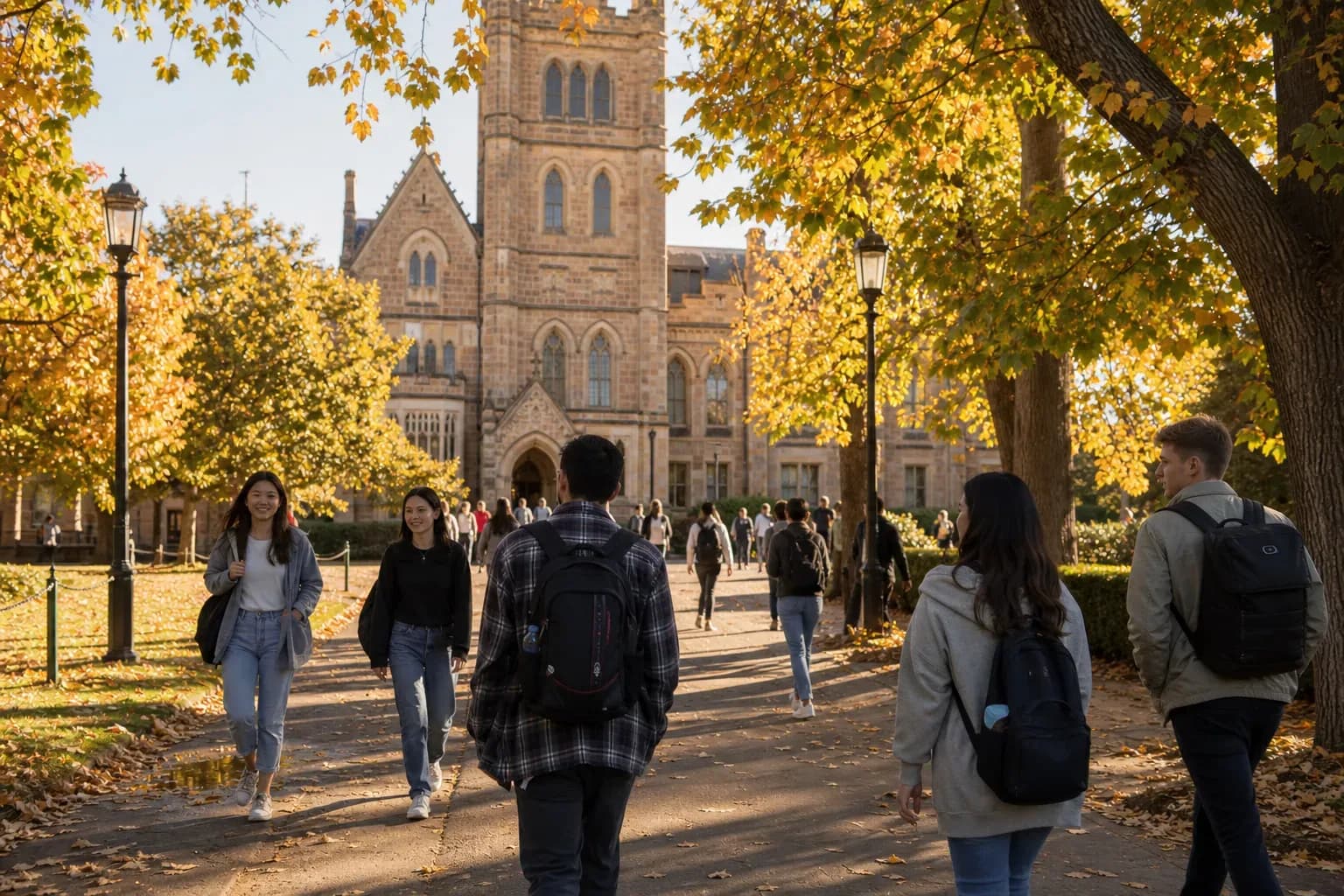
Australian Catholic University (ACU): A Flagship for Teacher Education and Nursing, Seven-Campus Coverage, and a PR-Friendly Safety Net
Published on February 2, 2026
Australian Catholic University (ACU), ranked around #800 globally in QS 2026, is one of the easiest universities for Taiwanese families to overlook when considering Australia. Yet for certain pathways, its value is something the Go8 and other higher-ranked universities may not be able to offer. ACU is Australia's largest provider of Initial Teacher Education, has the second-largest Nursing program in Australia after Deakin, is Australia's only comprehensive university with campuses across seven major cities (North Sydney, Strathfield, Canberra, Ballarat, Melbourne, Brisbane, and Adelaide), and is also one of the most accessible universities for international students in terms of English requirements (IELTS 6.5 is enough for many programs, with no demanding extracurricular "spike" expectations).
But before we can discuss ACU's value, a few points must be made clear. First, it has a Catholic background but is fully open to international students: founded in 1991 through the merger of four Catholic teacher education colleges, including Catholic College of Education Sydney and Institute of Catholic Education Victoria, ACU does not require students to be Catholic and does not require any religious background. Its international student body includes Buddhists, Taoists, non-religious students, Muslims, Protestants, and students from many other backgrounds. Second, it is relatively small: total enrollment is around 35,000 across seven campuses. Compared with large public universities such as USYD and Monash, which often enroll 70,000-80,000 students, ACU is a mid-sized university. Third, its strengths and weaknesses are very clear: Education, Nursing, health sciences, theology, and sports science are its strengths; business, law, engineering, and pure sciences are relatively weaker areas. This gap is more obvious than at many other public universities. In this article, I will explain ACU's true positioning, why Taiwanese families can treat it as a safety-net option that is unlikely to reject them, and how to think about its PR pathway strategy.
1. Basic Information
| Item | Details |
|---|---|
| Founded | 1991 (formed through the merger of four Catholic teacher education colleges) |
| Location | Seven major city campuses (see below) |
| Campuses | North Sydney, Strathfield (Sydney), Canberra, Ballarat, Melbourne, Brisbane, Adelaide |
| Undergraduates | ~28,000 |
| Postgraduates | ~7,000 |
| Total students | Around 35,000 |
| Student-faculty ratio | 1:24 |
| Motto | Truth in Charity (Latin: In Veritate Et Caritate) |
| Type | Public university with Catholic heritage (public funding + Catholic tradition) |
ACU is Australia's only comprehensive university with "Catholic educational tradition" as its core DNA (Notre Dame Australia also has this tradition, but on a smaller scale). Although it is called a "Catholic university," ACU receives Australian federal public university funding, its degrees are accredited by the Tertiary Education Quality and Standards Agency (TEQSA), and its curriculum is fully secularized. For international students, the main difference from other Australian public universities is the campus culture of service plus theology as an elective option, not compulsory religious coursework.
2. World Rankings
| Ranking | Position |
|---|---|
| QS World 2026 | ~#800 |
| THE World 2026 | #401-500 |
| ARWU / Shanghai 2024 | #601-700 |
| QS Education | Global Top 150 (among Australia's stronger universities) |
| QS Nursing | Global Top 100 |
| QS Theology, Divinity & Religious Studies | Global Top 50 |
| QS Sports-Related Subjects | Global Top 100 |
ACU's overall QS ranking is relatively low (in a similar tier to Murdoch and Bond), but its subject rankings in Education, Nursing, theology, and sports science have long been strong globally. A global Top 50 ranking in Theology / Divinity is ACU's most distinctive calling card. It is the only Australian university ranked near the top of the world in theology, but for 99% of Taiwanese international students, this is not the major they are applying for, so the strategic value of this indicator is limited. For Taiwanese families, the real focus should be Education and Nursing. In these two fields, ACU's world-class strength is something even mid-tier Go8 universities such as Adelaide and UWA may not necessarily match.
3. Admissions Data (International Students, 2026 Intake Year)
| Indicator | Value |
|---|---|
| International student ATAR equivalent | 65-85 (depending on program) |
| IB Diploma | 24-32 points |
| Approximate threshold for Taiwanese high school GPA | Top 40-60% of class + average of 75 or above |
| IELTS requirement | 6.5 (no band below 6.0), Education and Nursing 7.0-7.5 |
| TOEFL iBT | 70-79 (Education and Nursing 94+) |
| Application fee | AUD 100 |
| International student ratio | Around 15% (average across seven campuses, lower than the Go8) |
| Bachelor of Education entry threshold | ATAR 70 / IB 26 + LANTITE (Australian teacher basic skills test) |
| Bachelor of Nursing entry threshold | ATAR 75 / IB 28 + IELTS 7.0 (Listening/Reading 7.0, Writing/Speaking 7.0) |
| Bachelor of Business entry threshold | ATAR 65 / IB 24 |
International Students
- International students account for around 15% of enrollment, much lower than the Go8 (30-40%), so the campus remains mainly Australian domestic students
- Students come from 80+ countries, mainly India, the Philippines, China, and Vietnam
- Around 30-50 Taiwanese students enroll each year
- Important: ACU is one of the most admission-friendly universities in Australia. IELTS 6.5 is sufficient for many programs, there are no demanding extracurricular spike requirements, most programs do not require application essays, and admissions are rolling. This accessibility makes ACU a safety-net option for Taiwanese families whose profile is not especially strong but who still want an Australian degree
4. Tuition and Financial Aid
2026 International Student Tuition (Annual)
| Program Category | Annual Tuition in AUD | NTD Equivalent (AUD 1 = NTD 22.6) |
|---|---|---|
| Bachelor of Arts | Around AUD 30,000 | Around NTD 680,000 |
| Bachelor of Education (Primary / Secondary) | Around AUD 30,000 | Around NTD 680,000 |
| Bachelor of Nursing | Around AUD 35,000 | Around NTD 790,000 |
| Bachelor of Business | Around AUD 32,000 | Around NTD 720,000 |
| Bachelor of Exercise Science | Around AUD 34,000 | Around NTD 770,000 |
| Bachelor of Theology / Philosophy | Around AUD 28,000 | Around NTD 630,000 |
| Master of Teaching | Around AUD 32,000 | Around NTD 720,000 |
| Master of Nursing Practice | Around AUD 36,000 | Around NTD 810,000 |
| Living costs (Ballarat / Adelaide) | Around AUD 22,000-28,000 | Around NTD 500,000-630,000 |
| Living costs (North Sydney / Melbourne) | Around AUD 28,000-36,000 | Around NTD 630,000-810,000 |
ACU tuition is AUD 5,000-10,000 per year cheaper than the Go8. Total tuition for a three-year Bachelor is around AUD 90,000-105,000 (NTD 2.03-2.37 million), about NTD 500,000-800,000 cheaper than comparable programs at USYD or UNSW. Living costs at the Ballarat and Adelaide campuses are another 20-30% cheaper. A studio or room in Ballarat can cost around AUD 200-300 per week, making it the most affordable option among ACU's seven campuses.
Scholarships
- ACU International Student Scholarship: 20-50% tuition reduction for undergraduate students; usually requires ATAR 85+ / IB 32+
- ACU Vice-Chancellor's Excellence Scholarship: full tuition reduction for top students (very limited)
- Faculty of Education and Arts Scholarships: individual awards for Education programs
- Country Education Foundation Awards: awards for students at regional campuses
The most realistic reminder for Taiwanese families is this: ACU's value is not in scholarships, but in lower tuition + accessible admissions + regional advantages. It is a safety choice that is unlikely to reject you, not a school you choose mainly to negotiate tuition after receiving an offer.
5. Program Structure: 3-Year Bachelor + Teacher / Nursing Career Outcomes
Not the Melbourne Model
ACU follows the traditional British-Australian three-year Bachelor structure. Education and Nursing programs are four years or professionally intensive where relevant (Honours-equivalent, including clinical placements). The Bachelor of Education and Bachelor of Nursing are ACU's two flagship programs. Both are designed as "direct pathways to professional registration":
- Bachelor of Education (Primary / Secondary, 4 years): graduates automatically meet the academic pathway for teacher registration in Australian states and territories. In the Australian education system, this is the standard route for entering public schools as a teacher
- Bachelor of Nursing (3 years): graduates automatically meet the academic pathway for AHPRA (Australian Health Practitioner Regulation Agency) nursing registration and can enter public or private hospitals in Australia
Signature Programs
- Bachelor of Education (Primary / Secondary): Australia's largest teacher education program, with strong employment pathways into public schools
- Bachelor of Nursing: the second-largest in Australia, with clinical placement partnerships across Catholic hospital systems such as Mercy Health, Calvary Health Care, and St Vincent's Hospital
- Master of Teaching (Primary / Secondary): a two-year program for students from non-education undergraduate backgrounds who want to transition into teaching
- Bachelor of Exercise and Sports Science: partial collaboration with the Australian Institute of Sport (AIS)
- Bachelor of Theology / Philosophy: one of Australia's few systematic theology programs
- Bachelor of Paramedicine: one of the few Australian degrees offering paramedic training
- Bachelor of Speech Pathology: a health sciences flagship that complements the nursing faculty
- Bachelor of Occupational Therapy: a professional occupational therapy degree
- Master of Nursing Practice: graduate-level advancement for registered nurses
What This Means for Taiwanese Students
- Pros: three-year Bachelor pathways to registration; lower tuition; regional advantages at Ballarat / Adelaide; accessible admissions
- Cons: programs outside Education and Nursing are not as strong; QS overall ranking is relatively low; low recognition among Taiwanese parents
- Consultant's advice: if you want to become a teacher in Australia, study nursing as a migration pathway, or pursue a regional PR route in Ballarat / Adelaide, ACU is the most pragmatic choice outside the Go8. If you want to study business, engineering, or pure sciences, the Go8 or other IRU universities will usually be a better fit
6. Campus Culture / University Personality
ACU's personality can be summed up in three words: service, career-oriented, and modernized church tradition. It does not have the sandstone tower atmosphere of USYD's 1850 heritage, the hard-edged engineering identity of UNSW, or the green suburban calm of Macquarie. It is a "teacher + nursing professional training network" assembled across seven city campuses. The first impression you get when entering any ACU campus is that it feels more like a professional college than a research university: smaller campus scale, practical student composition, and a clear future career orientation.
The student body tends to include Australian local Catholic families + Filipino and Indian international students + many mature students (working nurses returning for further study, or career changers moving into teaching). ACU has one of the highest proportions of mature working students among Australian universities. Many professionals in their 30s and 40s return to ACU to study a Master of Teaching and switch into teaching, or complete a Master of Nursing to advance into specialist nursing. This DNA gives the campus a steady, goal-focused, unshowy atmosphere. It is not Bond's polished LAC feel, Macquarie's career-actuarial style, or Murdoch's ecological research identity. ACU is the school chosen by people who want to become good teachers, good nurses, and good therapists.
Student Clubs
- Around 50 clubs under the ACU Student Association
- ACU Nursing Students' Society: one of the representative nursing student associations in Australia
- ACU Teaching Students' Society: peer support for teacher education students
- Indigenous Higher Education Unit (Yalbalinga / Weemala): Indigenous education research and support
Sports Culture
- Each campus has its own sports facilities, with the Strathfield campus offering the most complete facilities
- Signature sports: Football, Netball, Rugby League
- ACU's Exercise and Sports Science programs have placement partnerships with multiple Australian professional sports teams
7. Location / Campus Environment
Seven Major City Campuses (Unique in Australia)
| Campus | City | Regional Classification | Features |
|---|---|---|---|
| North Sydney | North of Sydney CBD | Major Cities (no regional bonus) | Flagship campus for business and education |
| Strathfield | Inner West Sydney | Major Cities | Nursing, education, sports science |
| Canberra | Capital city | Major Cities | Education, theology, public policy |
| Ballarat | Regional Victoria | Regional Australia | Regional bonus + 2 years for 485 / 491 visa advantages |
| Melbourne | Melbourne CBD | Major Cities | Headquarters for education, nursing, theology |
| Brisbane | Brisbane | Major Cities | Education, nursing |
| Adelaide | Adelaide | City and Major Regional Centres | Regional bonus + 1 year for 485 |
This is ACU's most underestimated strategic value. The Ballarat campus is classified as Regional Australia, and the Adelaide campus is classified as City and Major Regional Centres. For PR points strategy, this matters:
- Ballarat campus: post-study 485 visa can receive +2 years (total 4 years), 491 regional visa advantages, and +5 PR points
- Adelaide campus: post-study 485 visa can receive +1 year (total 3 years), 491 regional visa advantages, and +5 PR points
For Taiwanese families pursuing a PR pathway, ACU Ballarat / Adelaide offers the full combination of lower tuition + regional advantages + accessible admissions + Education / Nursing occupations on the migration occupation lists. This strategic value is something no Go8 university can offer in the same way.
Climate
- Ballarat: winter 0-12°C (snow is possible in winter, making it one of the few Australian cities where snow can fall); summer 12-26°C; cool climate
- Adelaide: Mediterranean climate, hot and dry in summer, cool and wet in winter
- Sydney / Melbourne / Brisbane: see other articles
Campus Landmarks
- Tenison Woods House (North Sydney): main North Sydney building, a historic structure
- Mercy Building (Melbourne): teaching building on the Melbourne campus
- Aquinas Campus (Ballarat): the Ballarat campus, formerly Aquinas College
- St Patrick's Building (Strathfield): landmark of the Strathfield campus
8. Research and Resources
ACU's research funding is far smaller than that of the Go8 (annual research income around AUD 80 million), but its research density is concentrated in education, nursing, health sciences, theology, and Indigenous studies.
Key Research Institutes
- Institute for Learning Sciences and Teacher Education: research institute for learning sciences and teacher education
- Mary MacKillop Institute for Health Research: health research center on the Melbourne campus
- Institute for Religion and Critical Inquiry: institute for religion and critical inquiry
- National School of Education: Australia's largest school of education
- ACU Engagement Australia Plus (Yalbalinga): Indigenous education research and service
Signature Strength: Australia's Largest Scale in Education and Nursing
In Education and Nursing, ACU has a scale advantage that the Go8 cannot match:
| Field | Scale in Australia | ACU Strength |
|---|---|---|
| Initial Teacher Education | Largest in Australia | Major supplier of recruits for public schools across states |
| Nursing | Second-largest in Australia (after Deakin) | Tied to Mercy Health and Calvary hospital systems |
| Exercise and Sports Science | Among Australia's stronger programs | Partnerships with AIS and professional sports teams |
| Theology / Religious Studies | Largest in Australia | Major training institution for Australian clergy |
For students whose goal is PR, ACU's combination of "Master of Teaching + Ballarat / Adelaide regional campus + 485 regional extension of 1-2 years + 491 regional visa" is one of the most pragmatic PR channels for Taiwanese families willing to pursue the teaching route. Teachers, including Secondary School Teacher and Early Childhood Teacher, have long appeared on the MLTSSL skilled occupation list, making PR points relatively stable.
9. Notable Alumni
- Politics / public service: Tony Abbott (former Prime Minister of Australia, completed part of his studies), multiple education ministers across Australian states
- Education: many principals in Catholic Education Offices and public school leadership across Australian states
- Nursing / health: multiple leaders in the Royal College of Nursing Australia and senior executives at Mercy Health
- Clergy: multiple Catholic bishops and senior clergy in Australia
- Sports: many sports scientists and nutritionists working with Australian professional sports teams
The strongest marker of ACU's alumni network is education, nursing, health sciences, and clergy professions. Across Australian public schools and Catholic school systems, a substantial share of new teachers each year come from ACU. Senior nurse leadership in Catholic hospital systems such as Mercy, Calvary, and St Vincent's also includes many ACU graduates. This university's alumni network is one of the deepest in Australia's education and health service sectors, but recognition among Taiwanese parents is extremely low. This gap is something consultants need to explain clearly.
10. ACU Facts You May Not Know
- It was founded in 1991 through the merger of four Catholic teacher education colleges: Catholic College of Education Sydney (NSW), Institute of Catholic Education (Victoria), McAuley College (Queensland), and Signadou College (ACT). This merger gave ACU national multi-campus coverage from its first day.
- It is Australia's largest teacher education provider: the number of beginning teachers graduating each year exceeds that of any other Australian university. This scale advantage gives ACU alumni very high density in the public school system.
- No religious affiliation or religious courses are required: although it is called a "Catholic university," ACU accepts international students of all faiths and no faith, and programs do not require compulsory religion courses (theology is an elective or a major). This is a common misunderstanding among Taiwanese parents.
- Ballarat is one of the few Australian cities where snow can fall: occasional winter snow is possible. This is an experience students will not find in Sydney, Brisbane, or Perth, and can feel new for students from subtropical Taiwan.
- Mary MacKillop is Australia's first Catholic saint: an Australian nun and educator who lived from 1842 to 1909. ACU's health research institute is named after her, symbolizing the university's DNA of service and education.
- The motto In Veritate Et Caritate means "Truth in Charity" in Latin: it comes from Catholic tradition, but in program design it is rendered as "Truth in Charity." This spirit is reflected in ACU's student culture of social service.
11. Typical Admitted Student Profile
- Taiwanese international school students with predicted IB scores of 24-32 (Nursing 28+, Education 26+), or ATAR equivalent 65-85
- Taiwanese high school system: top 40-60% of class, with an average GPA of 75 or above
- IELTS 6.5-7.0 (Education / Nursing 7.0-7.5) or TOEFL iBT 79-100
- Extracurriculars: Education tracks may consider volunteer work / tutoring experience; Nursing tracks may consider hospital volunteering and community service; other programs have no spike extracurricular requirement
- Most programs require no interview; Nursing requires high IELTS scores rather than an interview
- Personal Statement is optional and not compulsory for most programs
- Suitable for strategic applications where families want an option that is unlikely to reject them. Taiwanese students with mid-range profiles can use ACU as a safety net
12. What Kind of Student Is ACU Best For?
✓ Best suited for:
- Students who want to become teachers in Australia (Master of Teaching / Bachelor of Education) and pursue PR
- Students who want to become nurses in Australia (Bachelor of Nursing) and pursue PR
- Families with mid-range profiles, IELTS 6.5, limited extracurricular spike, and a goal of obtaining an Australian degree
- Families on tighter budgets who want tuition to be NTD 500,000-800,000 cheaper than the Go8
- Students pursuing the Ballarat regional bonus route who are willing to live in a smaller town for 3-4 years
- Families pursuing the Adelaide regional bonus route who want medium-sized city life
- Students interested in health sciences such as Exercise Science, Speech Pathology, Occupational Therapy, and Paramedicine
✗ Not necessarily suitable for:
- Students who want to study business, engineering, pure sciences, CS, or AI (ACU is not strong in these fields)
- Families who care heavily about the "Go8 brand" and need stronger name recognition when returning to Taiwan after graduation (the Go8 is better recognized)
- Students who want pure research training and plan to pursue a PhD or academic career (the Go8 has deeper research resources)
- Students who feel uncomfortable with Catholic tradition (religion is not compulsory, but the campus culture does carry a service / charity-oriented Catholic DNA)
- Students who want a large-university feel, crowds, and a very broad club ecosystem (ACU has 35,000 students, about half the size of USYD / Monash)
Conclusion
ACU is one of the easiest Australian universities for Taiwanese families to skip, but it is also one of the most underestimated schools for specific pathways. QS #800 seriously undervalues its real strength in education, nursing, and health sciences, while its true value lies in being Australia's largest teacher education provider, having the country's second-largest nursing scale, covering seven major city campuses, offering regional advantages in Ballarat and Adelaide, charging NTD 500,000-800,000 less than the Go8, and maintaining accessible admissions requirements (IELTS 6.5 is enough for many programs, with no spike required). Put together, these strengths make it one of the most pragmatic safety nets for Taiwanese families whose goal is PR.
From an immigration strategy perspective, ACU has three advantages: (1) the Ballarat campus is in Regional Australia, giving graduates a 485 extension of +2 years, 491 regional visa advantages, and +5 PR points; (2) the Adelaide campus is in City and Major Regional Centres, giving students a +1 year 485 extension plus regional advantages; and (3) Secondary School Teacher, Early Childhood Teacher, and Registered Nurse have long appeared on the MLTSSL, giving these occupations stable PR points and strong job demand. In the Dr. G. Academy master's database, ACU's two combinations, "Master of Teaching + Ballarat regional route + 491 visa" and "Master of Nursing + Adelaide regional route + 491 visa," are among the most underestimated PR pathways for families with limited budgets.
Dr. G. has always been direct about niche but smart choices: ACU's ranking is not pretty, its business and engineering programs are not strong, and recognition among Taiwanese parents is extremely low. But for Taiwanese families with clear goals (becoming a teacher, becoming a nurse, pursuing PR), mid-range profiles, and tighter budgets, ACU is the most career-outcome-oriented safety net outside the Go8. It will not add shine to your resume, but it can help you obtain Australian teacher / nursing registration, enter regional job markets, and build enough points to reach the PR threshold. That is a professional PR pathway the Go8 may not necessarily provide.
ACU is the safety net built for families who do not need prestige, only results.